
Punching Depth or Full-Body Striking: Which Style Fits You?
Boxing develops combinations, counters and punch defense; kickboxing adds kicks, kick defense and longer range, with rules varying by format.
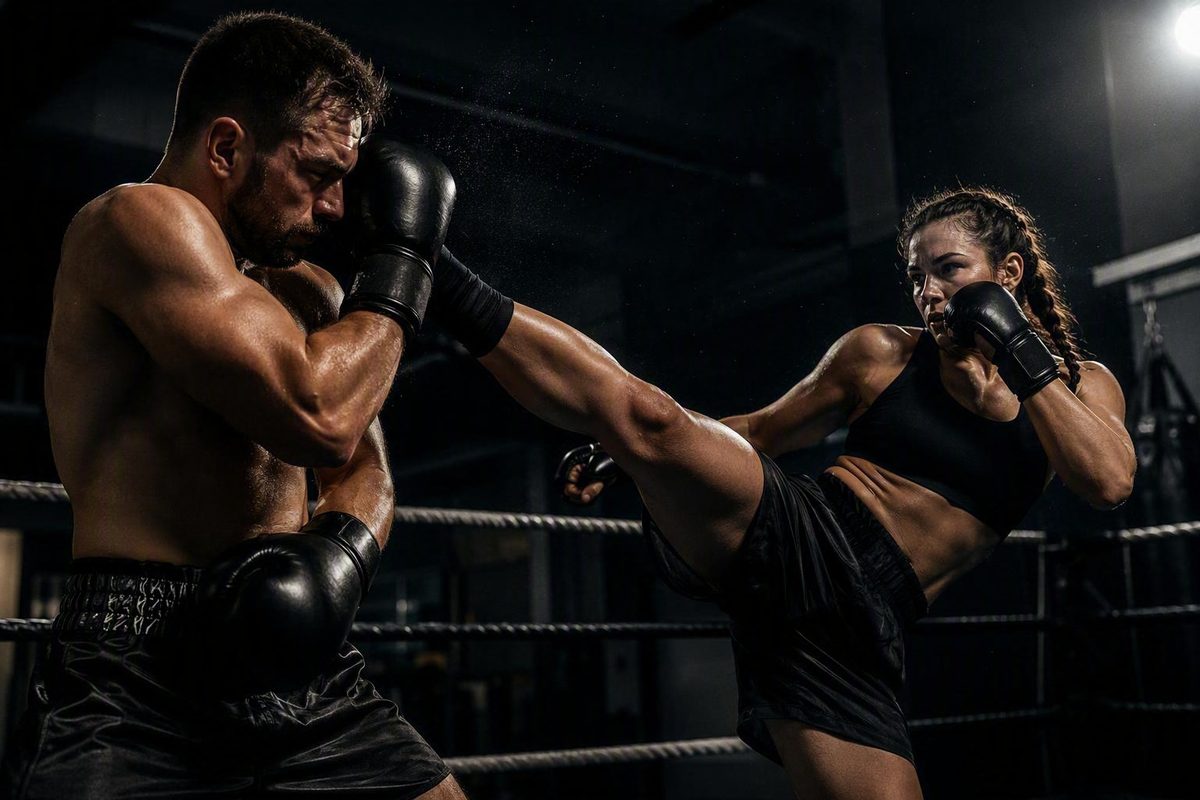
Boxing limits legal striking offense to punches, while kickboxing combines punches with kicks. Choose boxing if you want concentrated work on combinations, counters, head movement, and punch defense. Choose kickboxing if you want punch-kick combinations, kick defense, longer-range options, and more technical variety. “Kickboxing” is an umbrella category, however: knees, elbows, clinching, sweeps, leg kicks, and knockout rules vary by format. Neither sport is universally better, and for a beginner, the structure and contact culture of the available class may matter more than the name above the door. This broad distinction and its ruleset caveat are reflected in comparisons of boxing and multiple kickboxing formats.
Boxing vs. kickboxing at a glance
The central difference is specialization versus breadth. Boxing concentrates training on punches and the movement, timing, positioning, and defense needed to use them. Kickboxing retains punches but adds kicks and the demands of attacking and defending across kicking range.
| Factor | Boxing | Kickboxing |
|---|---|---|
| Striking tools | Punches | Punches and kicks; other tools vary |
| Technical emphasis | Punch mechanics, combinations, counters, head movement | Kicking mechanics, punch-kick combinations, kick defense |
| Typical range | Primarily punching range | Punching range plus longer kicking range |
| Defensive priorities | Slips, blocks, parries, footwork, punch awareness | Blocks, distance control, kick checks or other kick defenses |
| Mobility demands | Angles, lateral movement, rapid weight transfer | Movement plus balance and mobility for kicking |
| Common class work | Shadowboxing, mitts, bag work, combinations, defense | Bag and pad work, kicks, combinations, balance drills |
| Best fit | Punching depth and defensive hand fighting | Broader striking variety and full-body coordination |
A smaller legal toolkit does not make boxing technically shallow. It gives you more training time to refine punch mechanics, disguise attacks, create angles, build combinations, counter, and defend against an opponent who is also trying to punch.
Kickboxing distributes attention across more striking tools. In addition to learning punches, you may need to develop front and roundhouse kicks, connect hand and leg attacks, defend incoming kicks, maintain balance, and control a longer striking range.
The practical question is not which sport “wins.” It is which training process you want to repeat after a full day at work. A well-coached boxing class is a better choice than a chaotic kickboxing class, and the reverse is equally true.
What techniques and rules does each sport allow?
In boxing, punches are the legal offensive strikes. The Association of Boxing Commissions’ professional championship guidelines list kicking, knee and elbow strikes, wrestling actions, and deliberate clinching among prohibited conduct. Those ABC guidelines apply to specified professional championship contests and were modified in 2005, so they should not be treated as the current universal rulebook for every amateur and professional boxing contest.
Kickboxing generally permits punches and kicks. Everything beyond that foundation must be checked against the named organization or class format.
-
Glory-style example: A secondary account of Glory rules describes punches, kicks, and specified knee strikes as permitted while prohibiting elbows and unrestricted clinching. It also lists knockout, technical knockout, and judges’ points as possible results. The same account emphasizes that American, Dutch, Glory, K-1, and Muay Thai formats do not all use identical rules, so these are format-specific examples rather than a definition of kickboxing as a whole.
-
Light-contact example: The Northern BC Combat Challenge’s event rules prohibit knees, elbows, sweeps, excessive contact, and deliberate attempts to cause damage. Its light-contact division also prohibits intentional knockouts.
That contrast is why claims such as “kickboxing allows knees” or “kickboxing permits knockouts” need qualification. Some formats do; others do not. The same caution applies to elbows, prolonged clinching, kick catches, sweeps, leg kicks, legal targets, and contact intensity.
Muay Thai is closely related to kickboxing and may be grouped under that broad label in casual conversation, but it is not interchangeable with every kickboxing format. Elbows, knees, clinch work, scoring priorities, and permitted targets can differ. If a timetable simply says “kickboxing,” ask whether the curriculum follows American kickboxing, K-1-style rules, Dutch-style training, Muay Thai, a light-contact format, or a gym-specific mixture.
Boxing and many full-contact kickboxing formats can produce knockout victories or judges’ decisions, but that shared feature does not establish common rounds, scoring criteria, targets, equipment, or methods of victory. Those details belong to the relevant organization’s rules; a general comparison cannot settle them for a specific event. Broad boxing and kickboxing comparisons likewise describe both knockout and points outcomes while warning that kickboxing formats differ.
How training and defensive priorities differ
Beginner boxing instruction commonly starts with stance, guard, footwork, straight punches, hooks, and uppercuts. Students then connect those tools through combinations while developing feints, distance management, counters, blocks, parries, and evasive movement.
A representative boxing session may include:
- Shadowboxing
- Footwork and angle drills
- Heavy-bag combinations
- Mitt or partner-pad work
- Defensive reactions
- Controlled partner drills
- General conditioning
The emphasis is not merely on throwing punches. A boxer must learn when a punch is available, how to enter and leave range, how to maintain a usable position after attacking, and how to respond when an opponent returns fire.
Kickboxing retains much of that foundation but adds kicking mechanics and kick defense. Depending on the format, a beginner session may include front kicks, roundhouse kicks, punch-kick combinations, checks or blocks, mobility work, balance practice, and distance drills. A class that includes knees and clinch work will look different from an American-style kickboxing class focused primarily on punches and kicks.
The larger toolkit creates a bounded tactical difference: a kickboxer must manage attacks at kicking range as well as punching range. Hands can set up kicks, kicks can affect how the punching exchange develops, and defensive positioning must account for threats coming from both the opponent’s arms and legs.
That does not mean every boxer or kickboxer uses one fixed stance. Posture, stance width, guard, and weight distribution vary with the athlete, coach, opponent, drill, and competition rules. Beginners are better served by learning the reasoning behind a position than copying a universal-looking template.
Both disciplines still depend on the same underlying qualities: balance, timing, accuracy, guard discipline, conditioning, and purposeful footwork.
Shared footwork: a practical three-drill example
The following sequence is introductory movement practice adapted from a beginner boxing and kickboxing footwork tutorial.
Introductory movement box
Use a clear floor with enough room to move without encountering furniture, equipment, or other people. Work slowly enough to preserve your stance.
1. Relaxed bounce or controlled weight transfer — 30 seconds Shift your weight gently between your feet. A slight bounce is optional. Stay relaxed, balanced, and ready to move rather than trying to jump high or move quickly.
2. Advance and retreat — 30 seconds To advance, move the lead foot first and let the rear foot follow a comparable distance. To retreat, move the rear foot first and then the lead foot. Preserve your stance width instead of bringing your feet together.
3. Lateral movement — 30 seconds Step first with the foot nearest your direction of travel. The left foot initiates movement to the left; the right foot initiates movement to the right. Let the other foot follow without crossing your feet.
The shared goals are balance, stance maintenance, and controlled movement without crossing the feet. Speed is not the priority. If your feet repeatedly come together or your upper body pitches forward, reduce the distance of each step.
These drills are not a complete stance lesson. A coach watching you can identify details that written instructions cannot reliably reveal, including overreaching, dragging a foot, rising out of position, or losing the ability to strike and defend while moving.
Fitness class, technical training, or competition preparation?
Joining a boxing or kickboxing class does not automatically mean that you must spar. Class labels vary, but the useful distinction is between exercise performed without an opponent and combat-sport training that progressively adds interaction, defense, and live decision-making. Beginner kickboxing guidance likewise distinguishes fitness classes, which may involve no sparring, from combat-focused programs that add defense, reactions, partner work, and competition preparation. The class description and coach’s explanation should establish which one you are joining.
-
Non-contact fitness: Punches and possibly kicks are used as exercise through shadowboxing, bags, pads, or choreographed combinations. There may be no opponent interaction.
-
Technical partner training: Students practice range, timing, defense, and reactions through agreed attacks, limited choices, or controlled resistance.
-
Controlled sparring: Both partners make live decisions, but the coach limits pace, intensity, targets, or permitted techniques.
-
Light-contact competition: Athletes compete under a defined ruleset emphasizing control. Some events prohibit deliberate knockouts and excessive contact.
-
Full-contact competition: The applicable rules permit a higher level of contact and may allow a knockout result.
These formats are not interchangeable. Repeatedly striking pads or the air can develop familiarity with movement and provide a demanding workout, but it is not the same task as reading a live opponent.
Gloves and mouthguards are common in boxing and kickboxing partner work. Kickboxing sparring may also involve shin guards. Headgear, groin protection, hand wraps, footwear, glove size, and other requirements depend on the gym, activity, and ruleset. Ask what is needed for the first class before buying a full equipment bag.
Combat sports carry real injury risk. MMA Spark’s standing editorial position is that online guidance does not replace a qualified coach who can observe your technique, manage the room, match partners appropriately, and decide when you are ready for more resistance.
Before joining, ask how beginners are introduced to contact. “Sparring is optional” is useful, but it is not the whole answer. You also want to know whether technical partner work is available, how intensity is enforced, and what the coach does when someone ignores the agreed pace.
A beginner’s decision guide
Choose boxing if:
- Punching is the main attraction.
- You want to specialize in combinations and counters.
- Head movement, parries, blocks, and punch defense interest you.
- You enjoy lateral footwork, angles, timing, and range changes.
- You prefer developing a narrower striking toolkit in greater depth.
Choose kickboxing if:
- You actively want to learn kicks rather than merely tolerate them.
- Punch-kick combinations sound more engaging than punching alone.
- You want to practice defending kicks and managing longer range.
- Balance during kicks and whole-body striking appeal to you.
- You prefer greater technical variety, even if practice time is divided among more tools.
Hip mobility and comfort balancing on one leg are practical considerations, not automatic disqualifiers. If you have an existing limitation, explain it to the coach before class and ask how the session can be adapted.
When possible, take one beginner class in each discipline. Do not judge only by which workout felt harder or which coach gave the most intense first session. Compare the clarity of instruction, curriculum, treatment of beginners, contact expectations, partner matching, and whether you genuinely want to return.
Ask each gym:
- Is this class cardio-only, technical, or a mixture?
- What does a typical beginner session include?
- When do beginners start partner drills?
- Is sparring optional?
- How is sparring intensity controlled?
- What equipment is required for the first class and for later training?
- Which competitive ruleset, if any, shapes the curriculum?
- Are beginners separated from experienced competitors when appropriate?
- What options exist for students who do not want full-contact training?
Pick boxing for deeper specialization in punches and punch defense. Pick kickboxing for a broader striking toolkit that includes kicks. If both appeal, choose the gym with the clearer curriculum, saner contact progression, and schedule you can attend consistently.
Do all kickboxing styles allow knees and elbows?
No. Punches and kicks are the common core, but knees, elbows, clinching, sweeps, and legal kicking targets depend on the ruleset. Some formats allow specified knees while restricting elbows and prolonged clinching; some light-contact formats prohibit knees and elbows altogether.
Is cardio kickboxing the same as learning to spar?
No. Cardio kickboxing may use punches, kicks, bags, pads, and combinations as non-contact exercise. Sparring adds a live partner, defensive recognition, range management, timing adjustments, and controlled contact.