
Build MMA Footwork You Can Stop and Control
Learn which foot moves first, how to keep your stance, and three non-contact footwork drills that fit around recreational MMA classes.
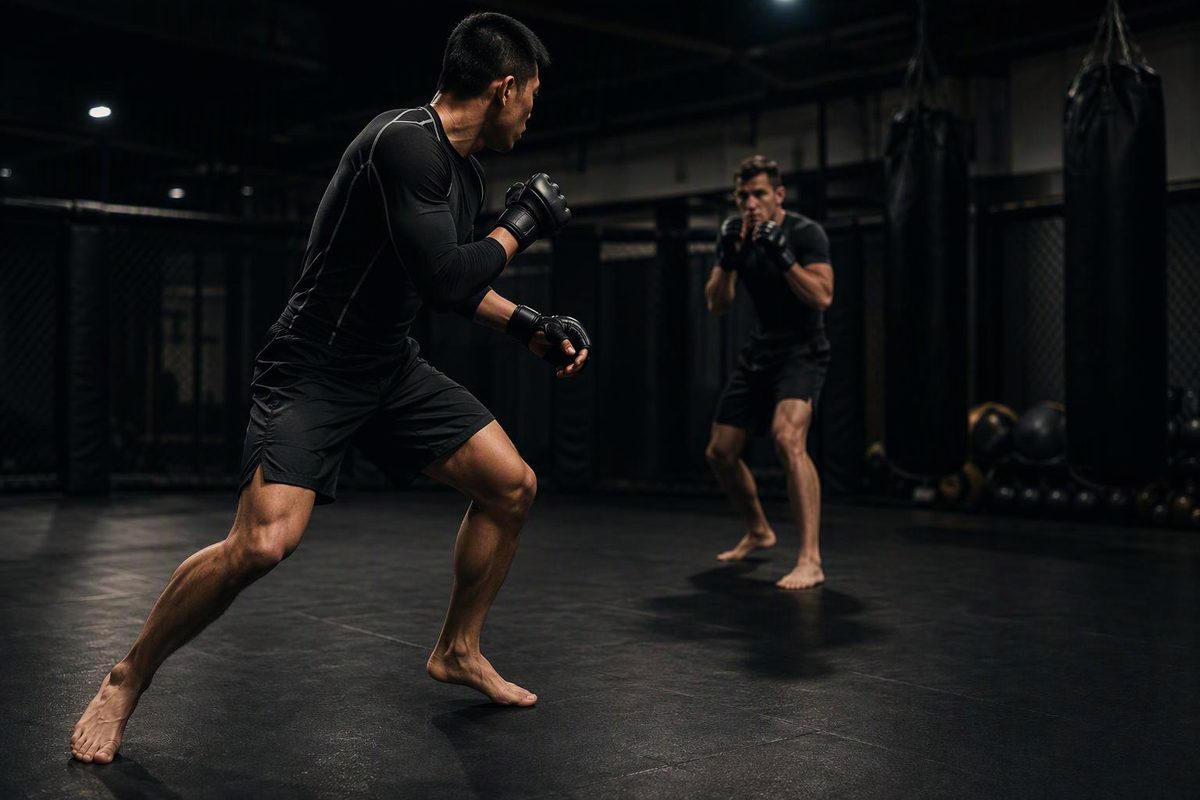
Good beginner footwork means moving into range, out of range and sideways without losing a usable stance. Start with small, controlled steps—not fast bouncing or complicated combinations.
Your first checkpoint is simple: can you stop after a step without needing another step to regain your balance? Use that as a practice cue, then have your MMA coach check your stance and movement.
Set up a stance you can move from
Use the stance taught in your MMA class. An orthodox stance has the left foot forward; a southpaw stance has the right foot forward. If you need help with the latter, see the southpaw setup and drills.
For this practice:
- Keep your feet separated sideways as well as front to back, rather than standing on one narrow line.
- Keep your knees slightly bent, hands in your guard and eyes forward.
- Keep your upper body controlled rather than leaning forward to reach an imaginary opponent.
- Begin with steps small enough that you can finish in roughly the stance you started with.
The AIBA Coaches Manual, sections 2.5.1–2.5.2, identifies overly narrow and overly wide stances as basic movement problems. Its boxing steps provide a useful starting pattern, not a complete MMA stance prescription.
MMA adds kicks, clinching and takedowns to the movement problem. Apex MMA’s striking guidance specifically emphasizes distance management and avoiding overcommitted movement because of the takedown threat. Let your coach adjust your stance for those demands rather than copying a boxer’s exact foot angles.
Which foot moves first?
For a basic step-and-follow movement, move the foot nearest the direction you want to travel first. The other foot follows to restore your stance.
| Direction | First foot to move | Then |
|---|---|---|
| Forward | Lead foot | Rear foot follows forward |
| Backward | Rear foot | Lead foot follows backward |
| Left | Left foot | Right foot follows left |
| Right | Right foot | Left foot follows right |
This is the directional sequence taught in the AIBA manual’s basic boxing steps. Your supporting foot supplies the push; “moves first” means the foot that travels first.
Do not bring the following foot all the way up beside the first foot. Restore the gap between them. For these beginner steps, avoid crossing your feet or deliberately switching stance. Advanced movement can use different patterns; this drill is about learning one dependable pattern first.
Three short, non-contact footwork drills
Use a clear, non-slip area with room to move in every direction. Follow your gym’s footwear rules. Warm up first, and stop if movement causes pain.
Try each drill for 60–90 seconds, resting as needed. This is a suggested practice format, not a fitness test. Keep the pace easy enough to notice mistakes.
1. Step, follow, freeze
Setup: Take your stance and choose a point ahead as your imaginary opponent.
Action: Take one small forward step, bring the rear foot along, then pause. Repeat backward, left and right. Reset between directions if necessary.
Checkpoint: At each pause, your hands remain up and your feet remain separated. You can take the next step in any direction without first untangling or repositioning your feet.
If your stance collapses, shorten the step. Speed comes later.
2. Move in, move out
Setup: Face the same imaginary target. Start without punches.
Action: Step forward and restore your stance; step backward and restore it again. After several controlled repetitions, add a relaxed jab—the straight lead-hand punch—once you have completed the forward movement, but only if your coach has already taught you that punch. Bring the hand back before moving out. Otherwise, keep this as a footwork-only drill.
Checkpoint: You are not reaching with your head or taking a giant backward step after the jab. Finish ready to move again.
Adding the punch after the step deliberately simplifies this drill. Ask your coach to teach the timing of a moving jab before trying to blend both actions at speed.
3. Add a sideways exit
Setup: Leave clear space on both sides.
Action: Step in, settle, then step sideways and restore your stance. If you have already learned the jab, add one relaxed shadow jab before stepping sideways. Alternate left and right between repetitions. Keep facing your imaginary opponent rather than turning your back.
Checkpoint: The sideways movement does not cross your feet or pull your hands down. This rehearses an exit option; neither direction is automatically safe against a real opponent.
Make it fit your classes
Use these drills as a brief add-on two or three times a week if they fit your recovery—not another exhausting workout after a hard class. If you start stumbling or losing your guard, slow down or finish.
When the solo steps are controlled, ask your coach for a no-contact mirror drill: one partner moves slowly while the other maintains an agreed distance. No surprise punches, kicks or takedowns. The useful progression is learning to respond to another person, not immediately adding harder contact.
At your next class, ask: “Am I keeping my stance when I change direction?” A coach who watches you move can give a more useful correction than another round of fast footwork drills.