
Ground and Pound: Learn Control Before Adding Strikes
Learn what ground and pound means in MMA, how control and defense work, and a coach-led practice progression without hard head contact.
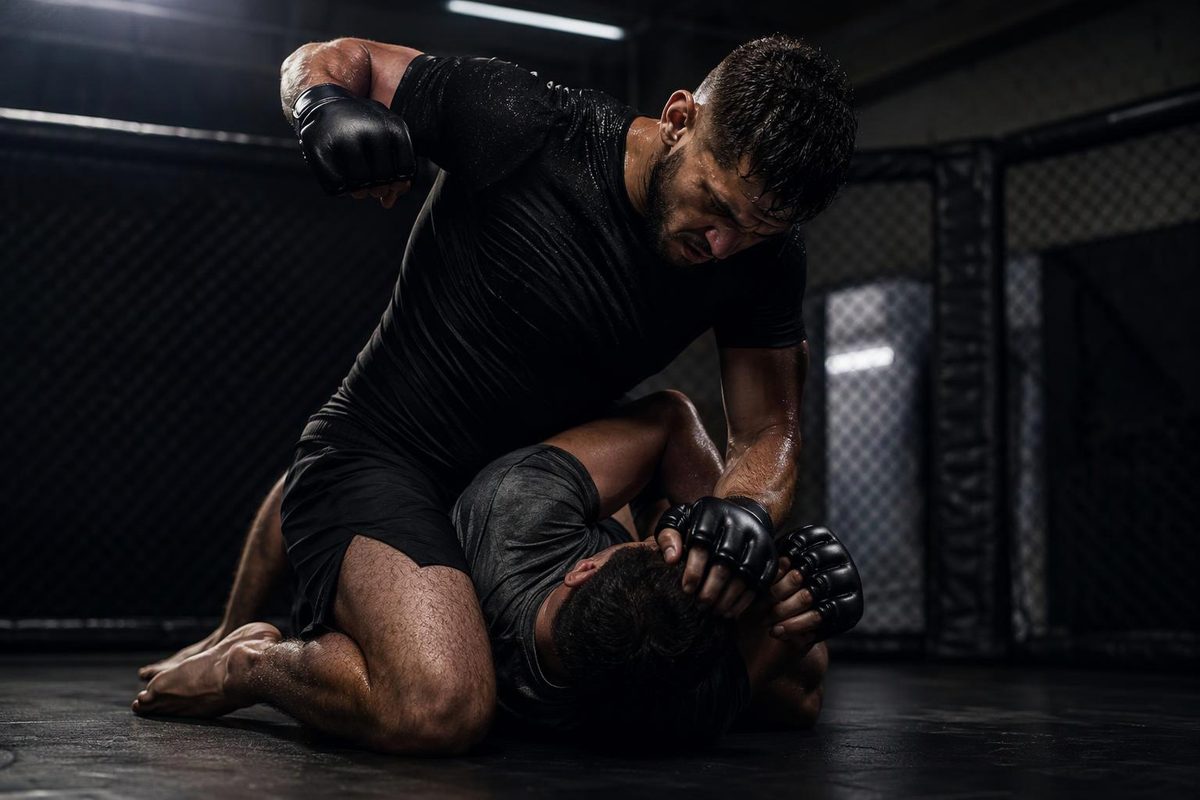
Ground and pound means combining control on the ground with strikes, usually from the top position. In competition, punches, hammer fists and permitted elbows can create openings, accumulate damage or lead to a stoppage. For a recreational beginner, the first task is simpler: keep your balance while freeing a hand, and learn how to deny that opportunity from underneath.
It is not just punching while kneeling. Evolve MMA’s technical guide emphasizes securing position before striking, then maintaining enough control to avoid reversals and submissions.
On top: control, create space, then reset
Ground striking creates a trade-off. Staying tight helps restrict movement, but you need some space to strike. Lifting away without controlling your partner can give them room to escape or attack.
Start with these coach-led priorities:
- Establish a stable base. Settle into the position before adding punches. Your partner’s movement should not immediately tip you forward or sideways.
- Keep control when one hand leaves. Use the remaining arm and your lower-body position to maintain balance. Do not release everything to swing with both hands.
- Use a compact striking motion. In drills, practice a short, deliberate path rather than a large wind-up. Power belongs on an appropriate pad or bag, not a beginner partner’s head.
- Recover your position. After a simulated strike, return to control. If your partner off-balances you, stabilize before continuing.
The position changes the problem:
| Top position | What to understand first |
|---|---|
| Inside guard—between the bottom fighter’s legs | Being on top does not remove submission or sweep threats. Do not chase punches while your posture collapses. |
| Half guard—one of your legs is trapped | Control the bottom fighter’s hips and upper body before creating striking space. |
| Side control—across their torso—or mount—straddling their torso | Passing the legs is not the end of the work. Settle the position and respond to escape attempts before lifting to strike. |
These distinctions follow Evolve’s position-by-position instruction. For your first drills, ask the coach to choose one position rather than trying every variation.
Checkpoint: Can you briefly free one hand while your partner moves lightly, then return it without losing position? If not, keep working on control without strikes.
Underneath: protect your head and change the distance
Covering up is an immediate defensive action, not a complete escape plan. From bottom guard, you also need to control the opponent’s arms and posture or create enough separation that they cannot comfortably punch.
Elliott Bayev’s ground-and-pound defense demonstration explains two useful directions:
- Bring them close. Protect your face and temples with your forearms, then use your guard and arm control to prevent the top fighter from sitting upright into punching space.
- Keep them farther away. When you cannot pull them close, work toward placing your legs between you and them. In the demonstrated double-knee shield, the knees come together against the opponent’s chest and the hips lift to increase separation. Ask your coach to check this alignment: knees against the chest with hips flat—or feet on the hips at the wrong distance—can still leave you within punching range.
Neither approach makes you immune to strikes. Practice the transition with a coach, then work toward a reversal or a controlled return to standing when space permits.
If you are mounted or pinned in side control, you cannot immediately use your legs as the same barrier. Ask the coach to connect head protection with an escape from that specific position. Do not improvise by turning away and exposing your back just to avoid a simulated punch.
Checkpoint: In slow practice, can you explain whether you are trying to close distance, create distance or recover your legs? That is more useful than holding a defensive shell indefinitely.
A beginner progression without head contact
Ask your coach to separate learning the movement from absorbing impact:
- Position only. Start in one agreed position. The top partner maintains control; the bottom partner attempts a basic escape at low resistance. No strikes.
- Add a hand-release cue. The top partner briefly frees a hand to show a striking opening, without punching. The bottom partner practices the agreed defensive response. Pause and reset when either person loses structure.
- Practice impact separately. Use a coach-positioned pad or suitable ground bag to practice compact punches and returning to balance. Never put a target over a partner’s face.
- Add restricted contact only when approved. If the coach introduces partner striking, agree on targets, intensity, equipment and stop signals first. Keep head strikes and elbows out of this beginner drill.
This is a suggested learning progression, not a requirement to start live sparring. A gym should be able to explain how it introduces contact; see what to expect in your first month of MMA.
Competition legality is not training permission
The ABC’s July 2024 Unified Rules prohibit strikes to the spine or back of the head, directed throat strikes, knees or kicks to a grounded opponent’s head, and stomping a grounded fighter. They also prohibit grabbing glove material to control an opponent; gripping the hand itself is different. Confirm the rules for your event rather than copying whatever you saw in a fight clip.
For hobby training, stop immediately for a tap, a verbal stop or uncertainty about your partner’s responsiveness. Headache, dizziness, confusion or vision problems after contact require stopping contact activity and seeking immediate medical evaluation—not another round to test yourself. The Association of Ringside Physicians recommends no same-day return when concussion is suspected.