
How to Practice the Superman Punch in MMA
Learn the Superman punch’s kick feint, rear-hand mechanics and low-kick setup, with balance checks and a controlled beginner practice progression.
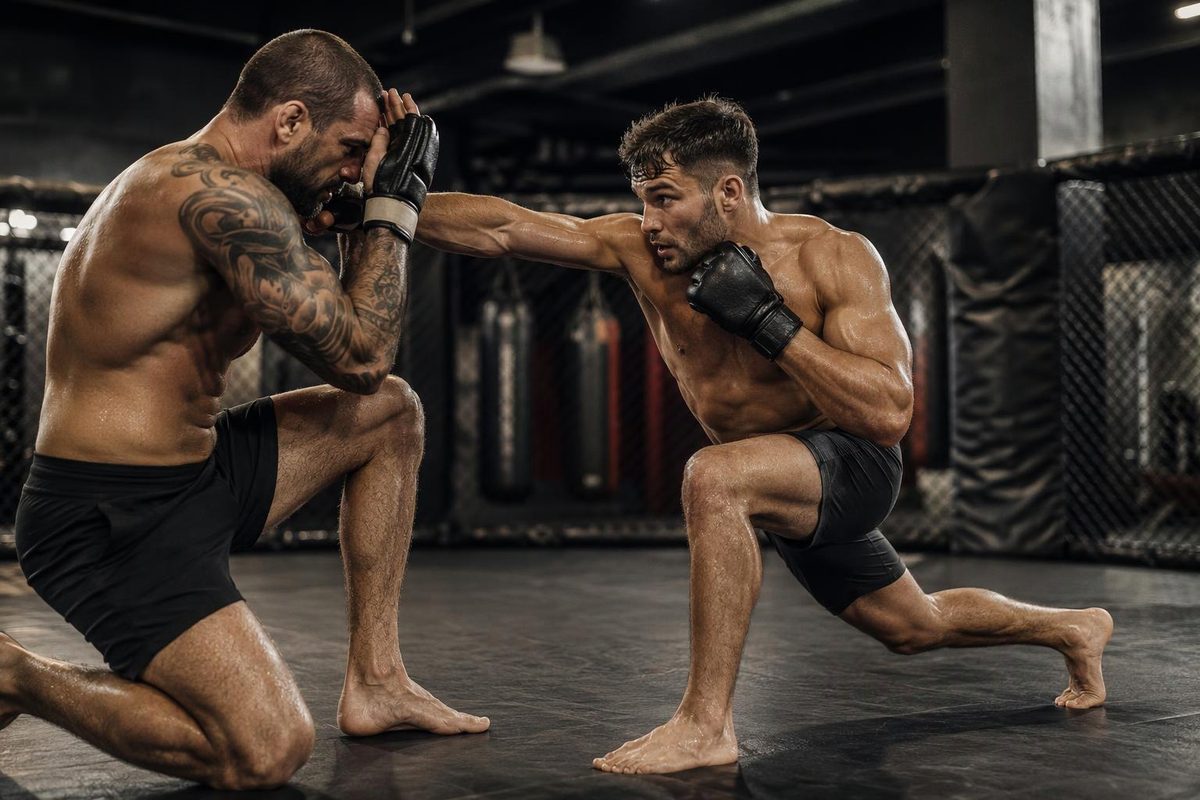
A Superman punch is a straight punch disguised by a kick feint: you lift the rear leg as though starting a kick, send that leg backward, and punch with the rear hand as you move forward. Ubud Muay Thai’s technique guide describes this coordinated rear-leg and rear-arm action.
For a recreational MMA beginner, treat it as an addition to your basic striking, not a replacement for a balanced cross. Learn the movement without contact, then have a coach check the timing and landing before using it with a partner. Use a small forward hop for the drill below rather than trying to jump high.
How to throw the basic version
The steps below describe a rear-hand Superman punch from orthodox stance: left foot forward, right hand punching. In southpaw, reverse the sides.
- Start in your normal stance. Keep your hands up and leave yourself space to move forward. If you cannot throw a cross and return to balance yet, work on the basic punches first.
- Show the beginning of a rear kick. Lift your right knee with the same initial movement you use for the kick you are pretending to throw. Keep the motion compact; do not pause with the knee raised.
- Switch from kick to punch. Send the raised right leg backward while pushing off your supporting left foot into a small forward hop. Extend the right hand in a straight punch as those movements happen together—not after the leg has already returned to the floor.
- Keep the other hand home. Your left hand stays near your face rather than swinging backward for balance. Look toward the target instead of down at your feet.
- Recover your stance. Retract the punch and settle back into a usable base, with your hands ready to defend or move again.
The central coordination—rear-leg feint, backward leg action and rear-hand punch—is described in Ubud Muay Thai’s breakdown. Have your coach choose the entry footwork rather than adding a large preparatory step yourself.
Checkpoint: After each slow repetition, pause in your finishing stance. Can you step backward immediately without first untangling your feet? If not, shorten the hop and reset.
Set it up with a kick reaction
The feint needs to resemble something your partner has reason to expect. Simply lifting your knee does not guarantee that their guard will open.
At The Arena, striking coach Vince Salvador teaches a low-kick setup: show the low kick, observe the opponent’s check—lifting a leg to block—and then use the similar kick cue to deliver the punch instead. His aim is to catch the opponent responding to the kick while standing on one leg. See Salvador’s setup explanation.
For a cooperative drill, the sequence is:
- Agree on a light rear low kick and controlled check.
- Return to stance after the kick.
- Repeat the initial kick motion, but switch to the Superman punch toward a pad held by your coach.
- Recover your guard and stance before restarting.
Do not assume the check will happen every time. The lesson is to recognize a reaction, not memorize “one kick, then one punch.” A Chris Mauceri combination breakdown likewise emphasizes establishing a kick pattern before using the fake.
Practice without turning it into a sparring stunt
Use this progression as a coach-reviewed drill, not a test of power:
Shadowboxing: Perform a few slow repetitions with a minimal hop. Check coordination, the non-punching hand and your finishing stance. If you need a huge leap to make the movement work, simplify it.
Pads or bag: Add light contact once the movement is repeatable. Set the distance so you can reach without pitching your head and chest forward. Reset between attempts; do not chase a swinging bag with repeated jumps.
Cooperative partner work: Add the agreed kick-and-check setup under supervision. Keep the punch on a pad initially, rather than surprising a partner with a head strike.
Limited technical sparring: Only add it when your coach approves and both partners know it is part of the drill. Keep contact within the agreed intensity.
If the feint looks convincing but the landing leaves you unable to defend, the repetition is not finished. Reduce the distance or speed until the punch ends in a stance you can actually use.