
Build a Balanced Muay Thai Stance Before Adding Power
Set up your Muay Thai stance, check your balance and guard, and practice a five-minute non-contact drill—with adjustments for beginner MMA training.
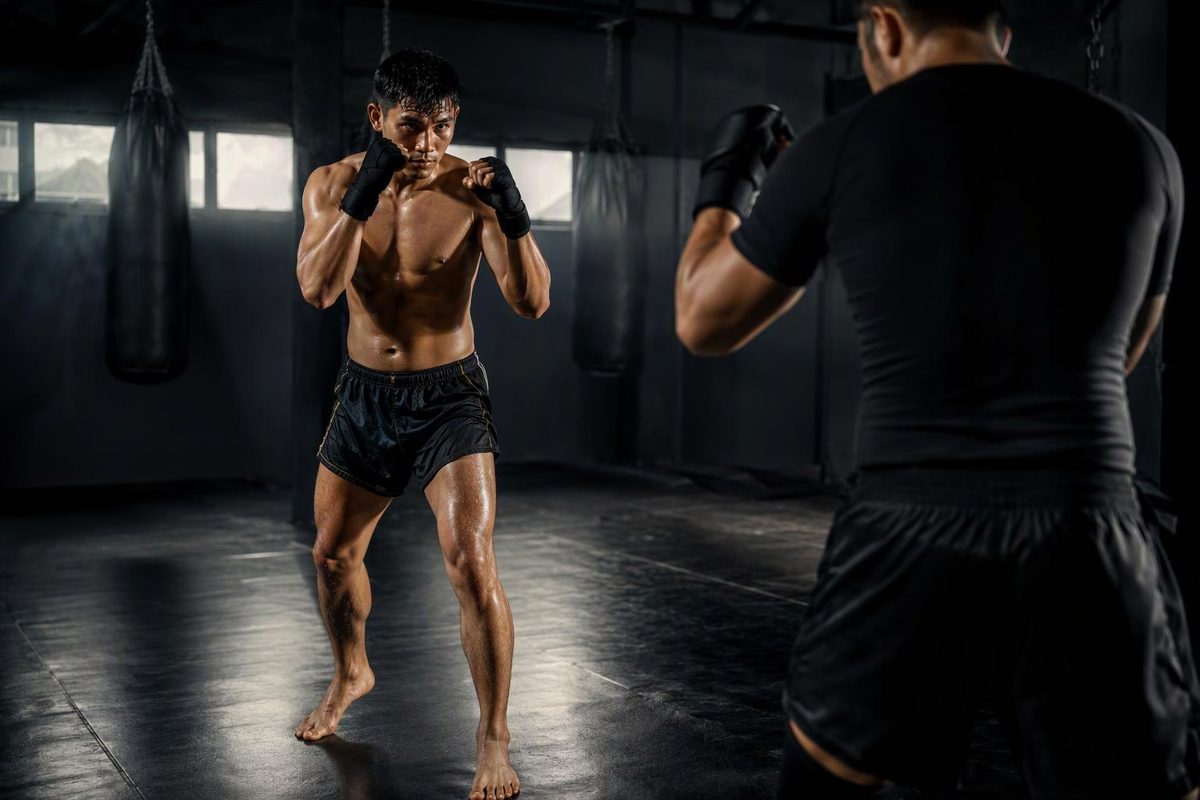
A beginner Muay Thai stance uses staggered feet about shoulder-width apart, soft knees, a relatively upright torso and a high guard. You face your opponent more squarely than in many boxing stances, while keeping one side forward. The aim is to move, strike and defend without having to rebuild your balance first—not to hold a rigid pose. Sean Fagan’s stance guide emphasizes a square position, high hands and a mobile base, while noting that individual stances vary.
Set up your stance
Use this as a starting point for a coach to check, rather than a shape you must force your body into.
- Choose your lead side. Orthodox means left foot and left hand forward; southpaw means right foot and right hand forward. The stronger side commonly goes at the rear, but let your coach help you choose. If you train right-side-forward, see the southpaw stance guide.
- Stagger your feet without lining them up. Start about shoulder-width apart, then place your rear foot a comfortable distance behind you. Think two tracks, not a tightrope. Keep the lead foot generally forward and the rear foot angled slightly outward; don’t force an exact angle.
- Soften your knees and stay upright. Avoid both locked knees and a deep squat. Keep your torso relatively square to the imagined opponent rather than turning almost side-on. “Square” does not mean putting both feet level.
- Keep your rear heel light. A small lift is a useful starting cue—not a demand to stand high on tiptoe. You should still feel supported and able to take a small step in any direction.
- Raise your guard without shrugging. Keep your hands around cheek-to-eye height, elbows near your ribs and chin gently tucked, with your eyes forward. Relax your shoulders and keep breathing.
These cues combine Fagan’s stance principles with the soft-knee, high-hand setup taught in IMA Sports’ beginner guide. Coaches may teach different hand positions; learn your class’s basic guard before copying a fighter’s variation.
Where should your weight go?
Don’t chase a fixed weight percentage. Start with a balanced base rather than leaning heavily onto either leg.
Many traditional Muay Thai fighters carry more weight on the rear leg to free the lead leg for a check—lifting the shin to intercept a kick—or a teep, the pushing front kick. That is a functional adjustment, not a reason to lean your shoulders backward. Evolve MMA explains this rear-weighted approach.
For a simple non-contact checkpoint, shift enough weight onto your rear leg to slowly lift your lead knee a little, then set the foot back down. Can you stay controlled without hopping, throwing your arms outward or taking a rescue step? If not, reset and ask your coach to check your width and weight distribution. This tests balance; it does not teach the full checking technique.
Move without losing the stance
For basic step-and-slide movement, move the foot nearest your destination first:
- Forward: lead foot, then rear foot.
- Backward: rear foot, then lead foot.
- Left: left foot, then right foot.
- Right: right foot, then left foot.
Take small steps and let the second foot restore your starting spacing. Avoid crossing your feet, bringing them together or reaching so far that you need to drag yourself back into position. These are the basic movement rules in Fagan’s footwork guidance. For more practice, use the beginner MMA footwork drills.
A five-minute non-contact practice
Use a clear, non-slip space. Keep this easy enough that it remains technique practice, not another tiring workout after work.
- Minute 1: Set your stance, relax, then reset several times.
- Minutes 2–3: Step forward, backward and sideways. Pause after each pair of steps to check your spacing and guard.
- Minute 4: Slowly lift and replace the lead knee. Reset between repetitions; skip this if it causes discomfort.
- Minute 5: Mix small steps with pauses. Finish each movement able to stop without an extra balancing step.
Slow down when your feet cross or your hands drift. Ask a coach to watch before adding speed, kicks or partner contact. You do not need someone kicking your leg to test this setup.
What changes for MMA?
Keep the Muay Thai fundamentals, but don’t assume the stance transfers unchanged. Takedowns add another threat: your base must also let you change level and defend wrestling entries. Evolve’s MMA adaptation guide highlights adjustments to stance, weight distribution and hand position.
Ask your MMA coach: “Can I check a kick and respond to a takedown from this stance?” Don’t solve that question by simply dropping your hands or widening your feet. Learn the adjustments in controlled, coach-led drills before using them in sparring.