
Parrying in MMA: Small Movements, Controlled Practice
Learn what parrying is, how to practice a compact jab parry, and which mistakes to avoid before adding counters or MMA sparring.
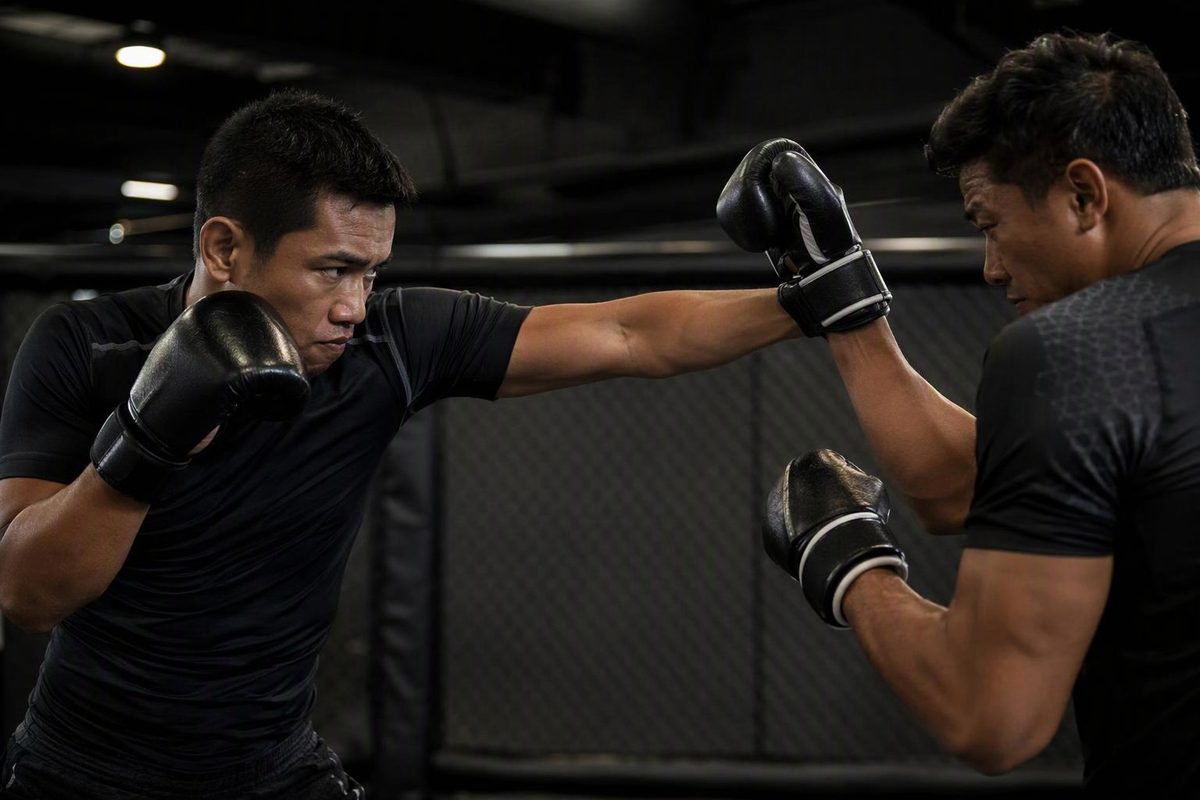
Parrying means redirecting an incoming strike rather than stopping it head-on. For a beginner, start with a compact parry against a straight jab: move the punch just off its path, then return your hand to guard. It is not a grab or a big slap. ExpertBoxing’s illustrated guide shows a simple downward parry with the rear hand kept close to the face.
Treat it as one defensive option—not a replacement for your guard, distance management or a coach watching your technique.
Parrying, blocking and slipping
These actions solve the same problem differently:
- Blocking: Put a glove or forearm in the punch’s path to stop or absorb it.
- Parrying: Make contact to change the punch’s direction.
- Slipping: Move your head off the punch’s line rather than intercepting it with your hand.
The England Boxing coaching handbook teaches all three, alongside footwork defenses. Its parry guidance emphasizes a short movement, no reaching, and an immediate return to guard.
For this first drill, use only straight jabs. Do not try to use the same little hand tap against every hook, kick or close-range attack.
How to parry a jab
This example assumes both partners are orthodox, meaning the left foot and left hand are forward. The defender uses the right, rear hand to parry the partner’s left jab. Have your coach adjust the setup for other stance matchups.
- Set your stance. Keep your knees soft, chin tucked and hands in the guard your coach teaches. Stay balanced rather than leaning forward to reach the punch.
- Keep the movement near your guard. As the jab approaches, turn your right palm toward the incoming glove. Do not extend your arm to chase it.
- Redirect, don’t swat. Use a small downward tap against the glove near the wrist, enough to take the jab below its original line. Keep your left hand protecting you and avoid flaring the right elbow.
- Recover immediately. Bring the right hand back to guard. Finish balanced and able to defend again—not with your hand hanging at chest height.
The downward action follows ExpertBoxing’s jab-parry demonstration. England Boxing describes an outside parry with a short inward rotation rather than this downward tap, but its coaching points reinforce the same habits: compact movement, tucked elbow and guard recovery.
Checkpoint: Can you redirect the glove without reaching, losing your stance or moving your other hand? If not, slow the feed down rather than slapping harder.
A controlled partner progression
Ask your coach to supervise the first partner attempts. Agree on the allowed attack, speed and contact before starting. This is a technique drill, not permission to test each other with surprise punches.
1. Learn the contact without a head target
Present your right glove slightly in front of your normal guard. Your partner slowly extends a jab toward that glove—not your face. Tap it down and reset completely. Try five deliberate repetitions, then swap roles.
This rehearses the contact and recovery. It does not yet test realistic defensive timing.
2. Add timing under supervision
Have the coach set the range, target and a controlled jab feed that does not require head contact. Keep it jab-only, with no counters initially. If misses produce unintended head contact, stop and simplify the setup.
Once the motion stays compact, the feeder can vary the pause between jabs. Later, add occasional feints—pretend attacks—to check that you are not throwing your hand down at every twitch.
3. Add one counter to a pad
Only after the parry and recovery are reliable, add a single coach-chosen counter to a pad. Have the coach check the pad position so the counter is not directed into the holder’s face. In Dynamic Striking’s lesson featuring Duane Ludwig, beginners first return to guard after parrying, then add the counter once comfortable; the lesson also warns against holding the pad too close to the face. You do not need his more advanced overhand sequence for your first session.
Mistakes to catch before sparring
England Boxing flags reaching, excessive sideways movement, a flared elbow and failure to recover the guard as common parry errors. A useful cue is: small touch, hand home.
Do not assume success in a jab-only drill transfers automatically to mixed MMA rounds. Ask your coach to add combinations, kicks and takedown threats gradually, with explicit limits. Keep developing basic MMA footwork, too: sometimes the task is to leave range, not intercept another punch.
For recreational training, finish the drill when your movement becomes sloppy. Getting extra repetitions is not worth turning a controlled practice into unwanted contact before tomorrow’s workday.