
Forget the Countdown: Release the Choke at the Tap
Apply pressure gradually and release immediately at the tap—or whenever responsiveness is uncertain. Timing estimates are not training targets.
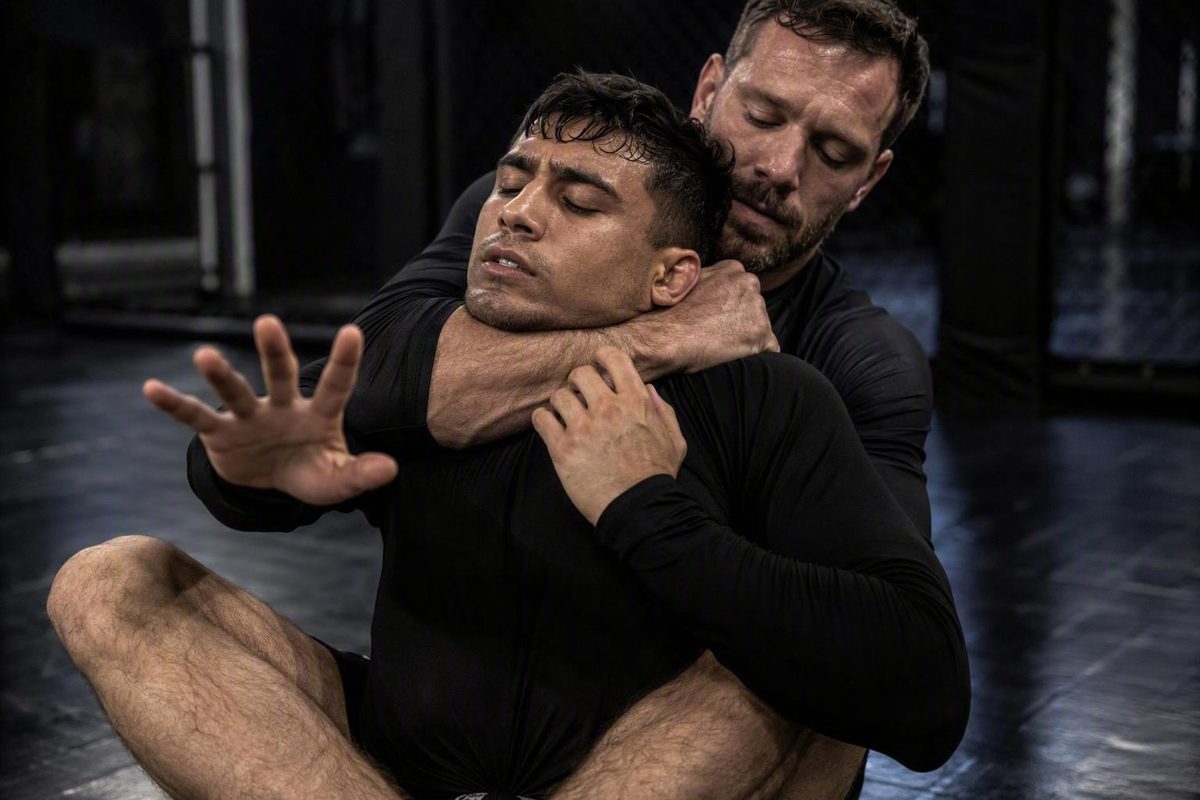
Do not hold a rear-naked choke for a preset number of seconds. In supervised MMA, BJJ, or submission-grappling training, apply pressure gradually and release immediately when your partner taps. If you think they may have become unresponsive, let go at once rather than waiting to confirm it. Timing estimates are not training targets.
The direct answer: hold only until the tap
A tap ends the submission. Release immediately—do not finish a countdown, wait for another signal, or add one last squeeze.
Before drilling, agree with your coach and partner on the stopping signals you will use.
Release is also required whenever responsiveness is in doubt. If your partner goes limp or stops responding normally, do not continue squeezing to find out whether the choke is fully secured. Grappling guidance specifically advises paying close attention and releasing at a tap or even a small possibility that the partner has lost consciousness (NAGA’s rear-naked-choke guidance).
Never use unconsciousness as the goal of a recreational drill or as a test of toughness. This guidance also does not replace a coach who can watch the practice directly, correct abrupt pressure and enforce stopping signals.
Why a number of seconds is the wrong benchmark
The sources reviewed do not establish a fixed five-, eight-, ten- or other number of seconds as a safe training window. They discuss how quickly unconsciousness might occur under certain conditions, but that is a different question from how long a trainee should continue applying a submission.
A possible time to unconsciousness is not permission to squeeze for that long. Your partner may tap earlier, and the hold must end when they do. If their responsiveness becomes uncertain before any tap, the hold must still be released.
A stopwatch also cannot tell a beginner whether the submission is being applied as intended. Martial-arts instructional sources identify force, placement and duration as important safety considerations and warn that incorrect or continued application can cause serious injury. Those sources do not provide a medically validated grace period after a tap, nor do they support deliberately waiting for unconsciousness.
Technique labels should not create false confidence either. Instructional descriptions commonly distinguish an intended restriction of blood flow from pressure on the airway or other parts of the neck, but live practice is not perfectly controlled. Beginners should therefore avoid making anatomical assumptions about what is being compressed and follow the simpler behavioral rule: apply gradually, monitor continuously and release when signaled.
If someone claims a particular duration is “safe,” ask what happens when the partner taps before the clock runs out. The answer must be immediate release.
A beginner-safe practice checklist
Before drilling:
- Agree on stopping signals. Confirm exactly how either partner will end the drill.
- Set the intensity. Use gradual, cooperative pressure rather than maximum force.
- Keep communication possible. Do not assume a partner will always have a free hand or be able to give the signal you expected.
- Ask about the response to an incident. Know how the coach will stop the session and activate the gym’s established emergency process if a trainee becomes unresponsive.
During the drill:
- Monitor your partner instead of focusing solely on completing the submission.
- Keep enough control to release without hesitation.
- Stop at the first agreed tap, even if the choke did not feel fully secured.
- Let go whenever responsiveness is uncertain.
- Do not encourage a partner to “hold out” so that you can test the technique.
Do not reapply the choke or rely on an assumed recovery time. This article does not provide a substitute first-aid protocol or predict how quickly someone will recover.
What responsible coaching looks like
A responsible training room treats tapping as ordinary communication. It means the exchange has ended, not that the person who tapped has failed. Students should be able to stop a drill early without being mocked, punished or pressured to continue.
MMA Spark’s beginner guidance favors learning positions, survival skills and escapes before emphasizing submissions. It also recommends controlled positional work rather than mandatory hard sparring for new students. This is a practical progression for hobbyists: first learn where you are, how to control your movement and how to communicate; then add submissions under supervision.
| Gym behavior | What it signals | What the beginner should do |
|---|---|---|
| Controlled positional work comes before open submission rounds | The curriculum prioritizes foundations | Learn the positions, escapes and stopping routine |
| Partners release at the first agreed tap | Stop signals are being enforced | Tap clearly and apply the same release standard |
| A coach mocks or punishes tapping | Students may be pressured to hide distress | Treat it as a serious warning sign |
| Beginners are pushed into mandatory hard sparring or uncontrolled submissions | Intensity is being prioritized over readiness | Decline the round and reassess the gym |
| Students are encouraged to continue after a tap | A basic safety boundary is being ignored | Stop participating in the drill |
A coach who merely watches while students hold submissions after a tap is not providing meaningful supervision.
Why the reported Fremantle duration is not a training benchmark
ABC reported that police alleged a rear chokehold was maintained for approximately 1 minute 50 seconds during a Fremantle confrontation. According to the report, a 63-year-old man lost consciousness and later died, while a 26-year-old junior doctor was charged with manslaughter (ABC’s initial report on the Fremantle case). A criminal charge is an allegation, not a finding of guilt, and the report did not establish the precise medical mechanism of death.
In a follow-up, ABC reported that the accused held a BJJ blue belt and had competed in submission-grappling tournaments. His lawyer characterized the choke as self-defense and said his client had been fearful during the confrontation (ABC’s follow-up report). Those are defense claims rather than adjudicated facts. Belt rank and competition history provide context but do not prove competence, intent, causation or legal responsibility.
The case also received coverage written for a BJJ audience, but that community report does not establish a medical threshold or a universally lethal duration. An alleged prolonged hold during an uncontrolled street confrontation cannot be converted into timing guidance for supervised recreational training.
The training rule is simpler: no countdown, no test of toughness and no waiting for unconsciousness. Apply submissions gradually under direct supervision, release at the first agreed tap or any doubt about responsiveness, and reconsider any gym that treats tapping as weakness.