
Choose Your Grappling Base by the Skills You Actually Want
Wrestling emphasizes takedowns, hand fighting, scrambles and top control; BJJ emphasizes guard, positional transitions, submissions and defense.
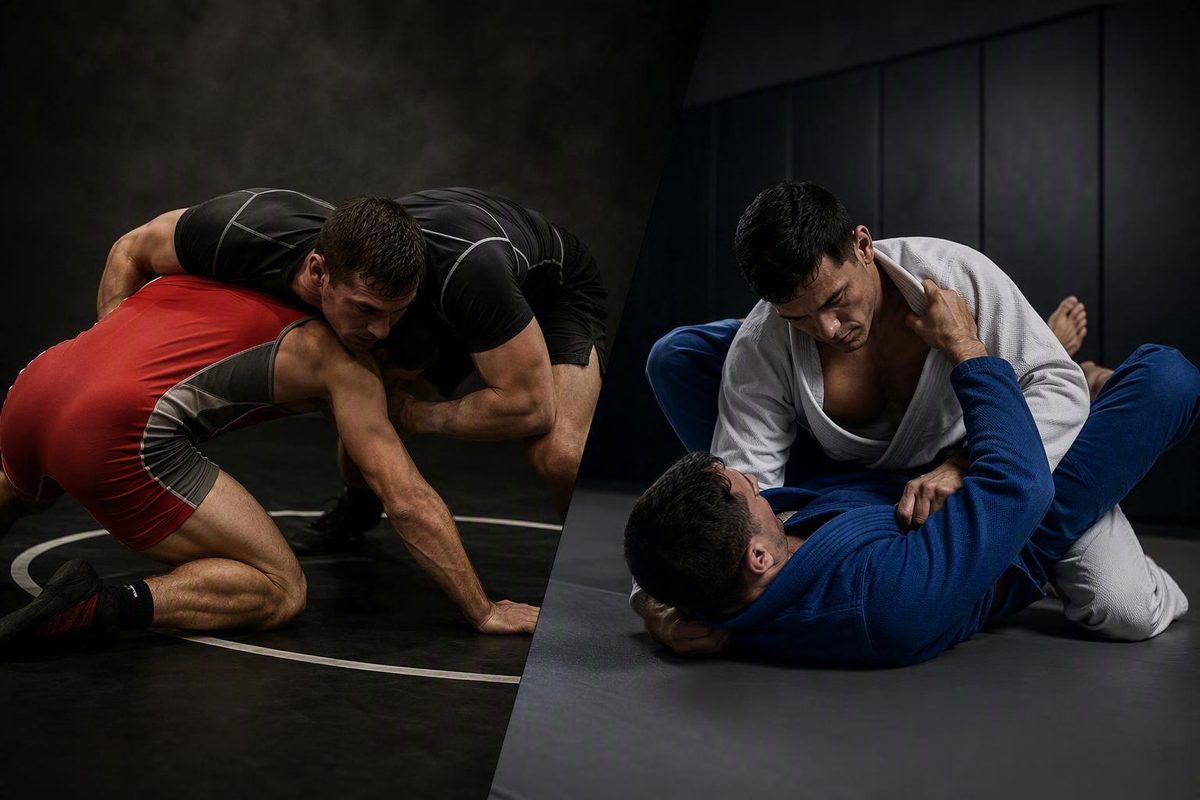
Start with wrestling if you mainly want takedowns, hand fighting, scrambling, and top control. Start with Brazilian Jiu-Jitsu (BJJ) if you mainly want guard work, positional transitions, submissions, and submission defense. If your long-term goal is MMA or rounded grappling, train both—but make one your primary discipline so a limited weekly schedule still produces focused progress.
The short answer: choose by goal, not reputation
| Your main goal | Best starting emphasis | Why |
|---|---|---|
| Takedowns and top control | Wrestling | Concentrated practice in entries, finishes, scrambles, and maintaining top position |
| Guard and submissions | BJJ | Direct practice in sweeps, passes, chokes, joint locks, and submission defense |
| MMA grappling | Both | Wrestling helps determine where the exchange occurs; BJJ addresses guards and submissions |
| Sustainable recreation | Best-run local class | Coaching, schedule, safety, and culture determine whether you can train consistently |
Neither discipline is universally better. Your experience, the coach’s competence, the rules being taught, the timetable, and local availability can matter more than the label on the door. A BJJ program with regular takedown practice may suit you better than a nominal wrestling class without an adult beginner pathway. The reverse can also be true.
Observe or try the actual beginner class. Look at how the coach structures instruction, matches partners, controls intensity, and introduces takedowns and live rounds. Compare the classes you can attend consistently rather than imaginary matchups between elite specialists.
This is a broad comparison. Folkstyle, freestyle, and Greco-Roman wrestling are distinct contexts, just as gi and no-gi BJJ—and different competition organizations—do not share every rule or training habit.
The central difference: pin and control versus position and submission
Both wrestling and BJJ are grappling disciplines whose standard sport formats generally exclude punches and kicks. They develop different habits because they reward different ways of controlling a resisting opponent.
Wrestling broadly prioritizes takedowns, control, back exposure, and pins. In the rulesets discussed here, matches can also be decided by points or technical superiority. Wrestling therefore has decisive finishes even though it does not permit BJJ-style submissions.
BJJ broadly prioritizes positional advancement and submission. Competitors use takedowns, sweeps, guard passes, mount, back control, chokes, and joint locks, with legal techniques varying by organization and division. Commonly described formats allow victory by submission or points. These broad competitive differences are summarized in this wrestling and BJJ rules comparison.
| Feature | Wrestling | BJJ |
|---|---|---|
| Primary objective | Takedown, control, expose the back, and pin or outscore | Advance position and submit or outscore |
| Standing emphasis | Usually central: hand fighting, entries, finishes, and defense | Varies considerably between programs |
| Bottom response | Build a base, escape, reverse, or regain top position | Escape, recover guard, sweep, submit, or stand |
| Submissions | Not permitted in the rulesets discussed | Permitted, subject to division-specific restrictions |
| Typical progression | Coaching and competitive level rather than belts | Commonly uses belt ranks |
| Major variations | Folkstyle, freestyle, and Greco-Roman | Gi, no-gi, and organization-specific formats |
For beginners, the practical difference is repetition. A wrestling room will usually provide more concentrated standing exchanges and scramble work. A BJJ room will usually spend more time on guard, passing, positional control, and submissions. These are tendencies, not guarantees, so inspect the curriculum.
Why the rules create different grappling habits
A ruleset shapes posture, reactions, and acceptable risks—not just the final score.
Exposing your back to the mat is strategically costly in wrestling. That encourages wrestlers to build a base, escape, reverse position, return to their feet, or fight urgently for top control. Remaining underneath without progressing is usually a poor tactical choice.
In BJJ, having your back on the mat is not itself a loss. Many BJJ formats also allow guard pulling, so a contested takedown does not occur in every match.
Consider one position-level example. From bottom, a wrestler may turn toward the knees to build a base and begin an escape. Under BJJ rules, that same movement can expose the back or neck to control and submissions. Conversely, a BJJ practitioner accustomed to settling into guard may concede the top-position battle rewarded in wrestling. This difference in competitive incentives is also central to practitioner accounts of cross-training wrestling and jiu-jitsu.
Neither reaction is universally correct outside its context. Guard is a sophisticated sport position, but it is not automatically desirable on a hard surface or where strikes are possible. Cross-training means learning when an established habit no longer fits the problem.
Do not treat either sport as one fixed ruleset
“Wrestling” can refer to folkstyle, freestyle, or Greco-Roman, among other contexts. Their legal actions, scoring priorities, and ground phases differ. One broad distinction is that Greco-Roman prohibits holds below the waist, while freestyle permits attacks involving the legs. That significantly changes standing exchanges, but it is not a complete explanation of either style.
BJJ also changes between gi and no-gi formats. The evidence here does not establish that one BJJ format offers a universal transfer advantage for a particular wrestling style.
Scoring, match duration, attire, legal techniques, and submission restrictions can vary by organization, age, experience level, and division. Before joining a gym, ask:
- Which wrestling style or BJJ format does this class teach?
- Does the class prepare students for a particular competition organization?
- How much class time is spent standing?
- Are takedowns included in live rounds?
- Which submissions are permitted for beginners?
- Is training modified for hobbyists who are not competing?
The exact class matters more than the broad style name.
Which discipline fits your goal?
There is no useful overall winner—only a more direct route to a particular outcome.
| Goal | More direct emphasis | Main limitation |
|---|---|---|
| Takedowns and pin-oriented top control | Wrestling | Does not teach submission offense under its sport rules |
| Guard, submissions, and submission defense | BJJ | Takedown depth varies by gym |
| MMA | Targeted cross-training | Neither sport covers the complete MMA problem |
| Fitness | A class you can repeat consistently | Workload depends on session design |
| Competition | Your intended ruleset | Skills must be adapted when rules change |
| Self-defense | No proven universal winner | Both leave significant situational gaps |
| Adult recreation | Best coaching, access, and culture | Style labels do not guarantee sustainable training |
For takedowns: Wrestling is the more direct specialization. It repeatedly trains stance, hand fighting, entries, finishes, sprawls, re-attacks, and scrambles. Some BJJ schools teach these areas well, but the amount of standing practice varies.
For submissions: BJJ is the direct choice because chokes, joint locks, positional setups, tapping, and submission defense are central to its rules.
For MMA: Each discipline solves only part of the problem. Wrestling can help determine whether an exchange stays standing or reaches the mat and who lands on top. BJJ adds guard work, passing, submission offense, and submission defense.
For fitness: Choose a class whose workload you can recover from and repeat. Practitioner commentary often characterizes wrestling as explosive and conditioning-intensive, but that does not make every wrestling class harder than every BJJ class. Coaching, round structure, partner behavior, and your intensity determine the actual demand.
For competition: Train the ruleset you plan to enter. Wrestling competition requires wrestling-specific preparation; gi and no-gi BJJ tournaments require familiarity with their own grips, scoring incentives, and legal techniques.
For self-defense: Neither discipline is proven universally superior here.
For adult recreation: Prioritize convenient access, structured beginner integration, controlled live work, and a schedule you can sustain. Do not assume BJJ is inherently gentle or wrestling inherently punishing; the individual room determines how training feels.
A practical cross-training plan for the three-evenings-a-week hobbyist
With three weekly sessions, devote two to your primary discipline and one to your most important gap:
- MMA beginner who struggles to stay upright: two MMA or wrestling-heavy sessions and one BJJ session focused on guard survival and submission defense.
- BJJ hobbyist with weak stand-up: two BJJ sessions and one wrestling or takedown-focused class.
- Former wrestler entering submission grappling: two BJJ sessions and one wrestling session to maintain existing strengths while adapting them.
Adjust intensity around sleep, soreness, work demands, and your coach’s guidance. Three technical sessions you can repeat are more useful than treating every evening as a test.
If you are a BJJ practitioner adding wrestling, prioritize:
- Functional stance and movement
- Basic hand fighting
- One reliable takedown entry and finish
- A sprawl with an immediate follow-up
- A stand-up from bottom
- Stable top control after the takedown
If you are a wrestler adding BJJ, prioritize:
- Posture and limb safety inside guard
- One controlled guard-passing sequence
- Back and neck awareness during scrambles
- Early recognition of common submissions
- Prompt tapping instead of powering through
- Modified escapes that do not expose the neck, arms, or back
For either path, begin with breakfalls, major positions, basic escapes, controlled takedowns, and positional rounds before high-intensity open sparring. There is no established universal number of sessions or reliable timeline for skill transfer. Progress depends on experience, coaching, attendance, practice design, and the destination ruleset.
Safety and gym choice matter more than style mythology
Grappling training carries real injury risk, but the available evidence does not establish whether wrestling or BJJ has a lower injury rate per athlete or training hour.
In one survey of BJJ training injuries, hands and fingers, feet and toes, and arms and elbows produced the highest overall reported counts. Skin infections, knee injuries, and foot and toe injuries were the most commonly reported medically diagnosed conditions. The survey included no wrestling comparison and did not report exposure-adjusted rates, so its raw counts cannot rank the sports for safety. It also included self-reported and self-diagnosed injuries, limiting what can be inferred from the results (PubMed abstract).
As practical gym-selection guidance, look for:
- A structured fundamentals curriculum
- Explicit breakfall and safe-landing instruction
- Controlled takedown progression
- Clear tapping and immediate-release norms
- Consistent mat and equipment hygiene
- Sensible partner matching
- Coaches who cap intensity
- Positional rounds before unrestricted hard rolling
- Permission to stop or modify training when necessary
Watch what happens when someone taps, asks to slow down, or makes a mistake. That reveals more about the room than medals or highlight videos. Online guidance can help you ask better questions, but it cannot replace a qualified coach who can observe you train.
Can a wrestler beat a BJJ practitioner?
Yes—and a BJJ practitioner can beat a wrestler. The likely result depends on the rules, size, experience, conditioning, and individual skill. Wrestling-specific habits are favored under wrestling rules, while submission knowledge substantially changes a BJJ contest. A hypothetical matchup cannot prove universal superiority.
Do wrestling and BJJ include striking?
Their standard sport formats generally exclude punches and kicks. Both are grappling disciplines. MMA combines grappling with striking, so neither a wrestling class nor a BJJ class should be mistaken for a complete MMA curriculum.
Can you win a wrestling match without submitting your opponent?
Yes. Submissions are not permitted in the wrestling rulesets discussed here. Depending on the specific format, a wrestler can win through a pin, points, or technical superiority.
Choose the best-run class that directly trains your main goal: wrestling for concentrated takedown and top-control development, BJJ for guard and submission development, or targeted cross-training for MMA. Judge the real gym by its coaching, safety, schedule, and beginner culture—not by claims that one style wins everywhere.