
How Control, Position, and Submissions Fit Together
See how position creates permitted finishes, why legality varies by event, and why beginners should learn defense and safe tapping before submissions.
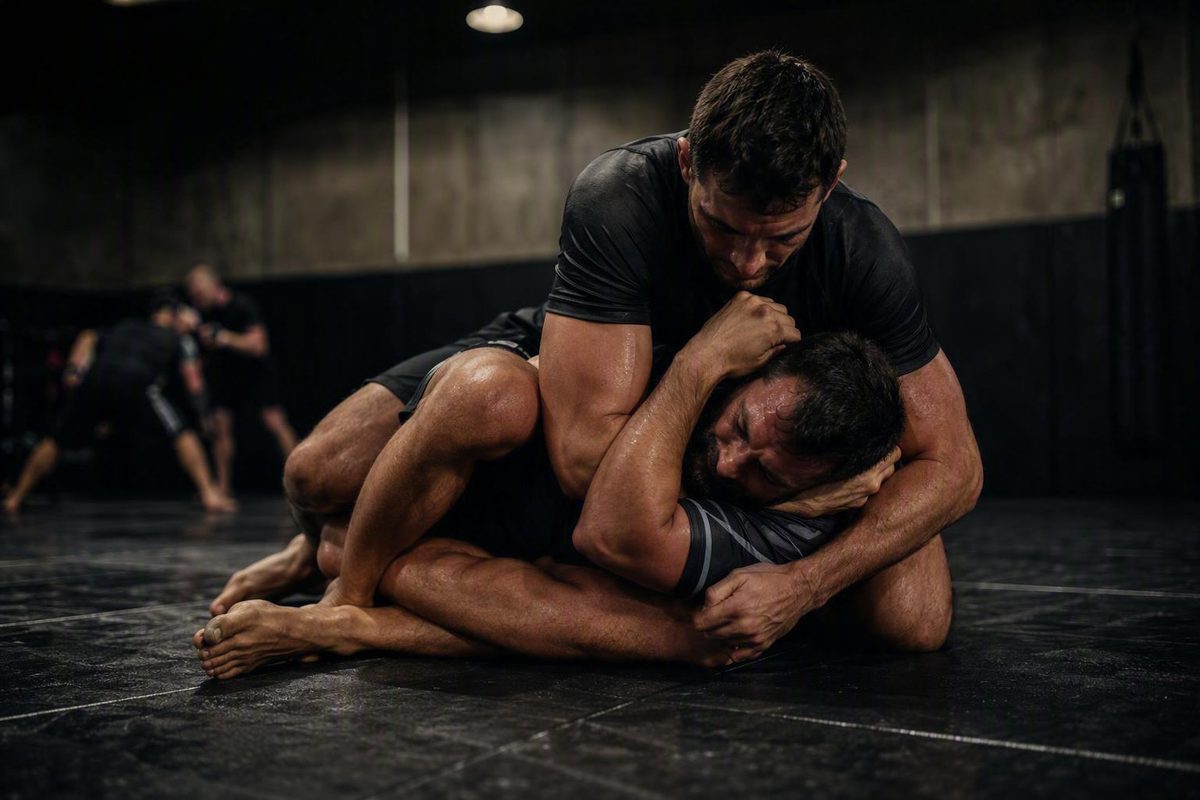
Submission fighting is best understood as control-to-finish grappling. Competitors establish or escape control, move between positions, limit an opponent’s options, isolate an eligible target, and pursue a choke or joint lock allowed by the applicable rules.
The submission is the endpoint—not the entire discipline.
For beginners, that distinction matters. A durable foundation begins with movement, positional recognition, escapes, control, and defense rather than a collection of isolated finishing holds. It is equally important to understand that “submission fighting” is a flexible label, not a single sport governed by one universal rulebook.
This article is therefore a general introduction, not an organization-specific rules guide or a substitute for direct coaching. Before training or competing, follow your gym’s instructions and consult the current rules for your exact event and division.
What submission fighting means
Submission fighting generally refers to grappling centered on clinching, ground fighting, positional control, escapes, transitions, and legal finishing holds. Those finishes usually fall into two broad families: chokes and joint locks. A match may end when an athlete taps, verbally submits, or is stopped under the applicable event rules.
The labels submission fighting, submission grappling, and submission wrestling are often used as equivalent or closely related terms. A tertiary overview describes them as names for a hybrid grappling discipline influenced by Brazilian jiu-jitsu, wrestling, judo, catch wrestling, and sambo. That terminology is descriptive, however, rather than binding on every school or promoter (overview of submission-wrestling terminology).
Usage varies by school, region, and organization. One academy might use “submission wrestling” for a no-gi class. Another might call a similar session “no-gi BJJ,” “grappling,” or “submission fighting.” Elsewhere, “submission fighting” may identify a particular event format rather than a complete martial art with a standardized curriculum.
It is therefore more useful to think of submission fighting as a family of related grappling practices. The common thread is the attempt to control an opponent and create a permitted submission while preventing the opponent from doing the same.
Its technical vocabulary draws from several traditions:
- Brazilian jiu-jitsu, especially guard work, positional advancement, escapes, chokes, and joint locks
- Wrestling systems, especially takedowns, rides, pressure, balance, and control
- Catch wrestling, including traditions of pins, rides, and submission holds
- Judo, including throws, pins, transitions, and groundwork
- Sambo, including takedowns, control, and submission attacks
- Luta Livre and other no-gi grappling traditions
A commercial martial-arts school’s summary similarly lists catch-as-catch-can, Luta Livre, freestyle wrestling, BJJ, judo, and sambo among the category’s influences. It also says “submission wrestling” usually—rather than always—refers to training or competition without a jacket or gi (submission-grappling terminology and influences).
These arts overlap, but they are not interchangeable. Modern submission fighting combines their concepts in different proportions. Because the available historical material is largely tertiary or school-published, a definitive single-origin story would overstate the evidence.
How control becomes a submission
A highlight may make a submission appear sudden. In practice, the finish is usually the final stage of a longer exchange:
- Establish or escape control.
- Advance, recover, or transition between positions.
- Limit the opponent’s movement and defensive options.
- Isolate an eligible target.
- Pursue a permitted finish while maintaining control.
The sequence is not always linear. An attacker may lose position and need to recover. A defender may escape a hold but remain underneath strong control. A failed submission can open a transition to another position—or give the opponent room to reverse the exchange.
Position gives the finish context
Position answers practical questions:
- Who controls distance?
- Who can move freely?
- Whose posture or alignment is compromised?
- Who can disengage, stand, turn, or expose the back?
A submission attempted without enough control may fail because the opponent can pull away, rotate, change angle, stand, or reverse the position. Stronger control narrows those choices. Submission fighting is therefore not merely a catalog of holds; positional decisions create or remove the opportunity to use them.
How an athlete concedes
An athlete commonly concedes by tapping the opponent or the mat or by submitting verbally. The precise signals and stoppage procedures depend on the gym or event. Before participating in live practice, beginners should ask which physical and verbal signals the gym recognizes, including what to do when their hands are trapped.
As conservative training guidance, any recognized tap or verbal concession should end the exchange immediately. The person applying the hold should release rather than add pressure or wait for further confirmation. Students should learn the local protocol directly from the supervising coach before live work begins.
Two broad finishing categories
Most familiar submissions fit into two broad categories:
- Chokes, which attack the neck
- Joint locks, which place pressure on a joint or connected structure
Joint locks can be divided further into upper-limb and lower-limb attacks. Rear-naked choke and triangle are common choke examples. Some attacks depend on gi collars, while others do not.
This classification helps beginners identify the general type of threat without turning a written guide into application instructions. Mechanics, defenses, permitted ranges, release behavior, and format-specific restrictions should be taught under direct supervision.
Submissions are not always the only route to victory
Depending on the format, specified actions or positions may earn points. General descriptions of submission-wrestling formats cite examples such as takedowns, reversals, guard passes, and dominant positions, but the value and definition of any action depend on the event (submission-wrestling overview).
In a point-based event, an athlete may win without submitting the opponent. Positional progress can matter because it creates finishing opportunities and affects the score.
Other formats place greater emphasis on obtaining a submission, potentially with little or no conventional positional scoring. These are broad format contrasts, not a universal classification system.
There is no single scoring system for everything called submission fighting. Only the current rules for a named event can establish how a match is scored and ended.
Why the ruleset matters
The question “Is this technique legal?” cannot be answered responsibly from the label submission fighting alone.
Rules may differ in:
- Clothing
- Scoring
- Match length
- Starting position and boundaries
- Permitted holds
- Participant restrictions
- Overtime or decision procedures
- Whether strikes are included
The available evidence does not include current governing-body rulebooks, so this guide cannot verify the legality of a named technique in a particular competition. Competitors must obtain the current rules for their exact organization and division and direct unresolved questions to the coach, organizer, or event officials.
Grappling-only is common, but the label is not conclusive
General references describe submission grappling primarily as clinch and ground fighting aimed at obtaining a submission. They also note that rules vary and that some broader uses of the category may include strikes.
Where strikes are allowed, positional choices change. An athlete must account for striking opportunities as well as control, escapes, and submissions. That makes a hybrid or MMA-oriented format materially different from a grappling-only class, even if both use some of the same positions.
Do not assume that strikes are either included or excluded solely because a class or event uses the phrase “submission fighting.” Ask for the applicable rules.
Point-based and submission-focused formats
A point-based format assigns value to specified actions or positions and may declare a winner on score when no submission occurs. A submission-focused format makes the finish the principal objective and may attach little or no conventional score to positional control.
That distinction affects tactics, but it does not divide every event into two neat boxes. Only that organizer’s current rules establish the actual format.
Never borrow legality from a video
An online demonstration proves only that someone demonstrated a technique. It does not establish that the technique is permitted in your class, age group, experience category, clothing format, or competition division.
Likewise, a hold appearing in a professional event is not evidence that a novice or amateur division permits it.
Before competing:
- Identify the exact organization and event.
- Find the current version of its rules.
- Confirm your age, experience, weight, and any rank-based division.
- Confirm whether the event is gi, no-gi, or another format.
- Ask the organizer or your coach about ambiguous wording.
A general article, an old video, or a teammate’s memory cannot replace that process.
Ranking also varies
No universal belt or ranking structure governs all submission-fighting schools and events.
Rank therefore does not translate perfectly between unrelated programs. Entrants should disclose their backgrounds accurately and use the organizer’s current classification criteria rather than assuming that a local class label determines the correct division.
Submission fighting compared with BJJ, wrestling, and MMA
Submission fighting overlaps substantially with Brazilian jiu-jitsu, wrestling, and MMA. The important differences concern objectives and constraints, not a universal ranking of effectiveness.
Brazilian jiu-jitsu
BJJ prominently emphasizes ground control, guard play, positional advancement, escapes, and submissions. That makes it a major technical influence on contemporary submission fighting. In many gyms, a no-gi BJJ class may look similar to what another gym calls submission grappling.
The terms remain context-dependent. A BJJ program may use a belt structure and organization-specific competition rules. A submission-fighting event may place different weight on takedowns, controls, finishing holds, or scoring. Local class names can blur these distinctions.
Wrestling
Common wrestling formats generally emphasize takedowns, control, escapes, reversals, exposure criteria, and pins rather than submission holds. Submission-oriented grappling adds legal finishes, changing the tactical meaning of positions.
This is not an effectiveness comparison. Wrestling contributes important skills to submission fighting, including takedowns, balance, pressure, scrambling, and controlling an opponent who is trying to stand.
MMA
MMA combines striking and grappling. Its athletes must account for standing strikes, clinch work, takedowns, ground control, submissions, and transitions between ranges.
Submission skills must therefore be adapted to MMA-specific constraints. Gloves, potential strikes, cage or wall positioning, and round structure can change which entries and controls are practical. A position that creates attacks in pure grappling may expose the athlete to strikes or lead to an unfavorable wall exchange in MMA.
A coach-practitioner writing about gi, no-gi, and MMA training identifies the cage, gloves, strikes, and transitions between ranges as constraints that distinguish MMA grappling from pure grappling. His analysis is practitioner commentary rather than a controlled comparison (practitioner analysis of gi, no-gi, and MMA constraints).
| Feature | Submission fighting/grappling | Brazilian jiu-jitsu | Common wrestling formats | MMA |
|---|---|---|---|---|
| Primary objective | Control and secure a permitted submission; scoring may also matter | Advance position and pursue submissions under the applicable BJJ format | Achieve takedowns, control, escapes, exposure, or pins under the relevant style | Win under the promotion’s striking, grappling, submission, and decision criteria |
| Submissions | Central in many formats | Central | Generally not part of common scholastic, freestyle, or Greco-Roman formats | Used within the promotion’s rules |
| Striking | Commonly absent, but the broad label alone is inconclusive | Commonly absent in sport BJJ | Absent in the common formats summarized here | A central component |
| Pins | Treatment depends on the event | Usually treated as control rather than an automatic match-ending pin | Often central or match-ending | Positional control may matter, but exact victory conditions depend on promotion rules |
| Clothing | Commonly no-gi, but not universally | Gi and no-gi formats | Style-specific competition and training attire | Gloves and promotion-specific attire |
| Ruleset variation | High across schools and promoters | Varies across organizations and divisions | Varies by wrestling style and governing format | Varies across promotions and jurisdictions |
The table is a general orientation, not a substitute for any sport’s official rules. The useful question is not which art is “best,” but what problem a particular ruleset asks the athlete to solve.
Gi and no-gi: shared principles, different controls
Submission wrestling is commonly associated with no-gi practice—typically fitted training clothing rather than a traditional jacket. This is common usage, not an absolute definition of all submission fighting.
The difference is more than wardrobe. Clothing changes available grips and therefore affects control, posture, pace, and attack selection.
What the gi adds
In gi grappling, the jacket and trousers provide gripping surfaces. Subject to the applicable format, practitioners may use material to help control posture or movement. The gi also enables collar-dependent attacks that do not transfer directly to standard no-gi practice.
The bow-and-arrow choke and X choke, for example, appear in public BJJ instructional lists and depend on collar material. They belong in a conceptual map of gi submissions, not a list of universal submission-fighting techniques.
Clothing grips and friction can make some controls more persistent. That does not mean every gi exchange is slow or that gi training is categorically better for developing control.
What no-gi emphasizes
Without clothing grips, practitioners rely more heavily on forms of connection such as:
- Underhooks and overhooks
- Head position and head control
- Wrist control
- Body locks
- Chest, hip, and limb positioning
No-gi movement may feel faster or more slippery because athletes cannot retain a sleeve or collar to slow movement. Control must come from body position and grips that do not depend on clothing.
The principles still overlap
Both formats require an understanding of:
- Balance and base
- Positional recognition
- Pressure and space
- Frames and connection
- Transitions and escapes
- Submission recognition and defense
- Timing and energy management
A student changing formats is not starting from zero, but habits need adjustment. A gi athlete must replace clothing grips; a no-gi athlete must learn how collars and sleeves alter posture, movement, and threats.
Should an MMA beginner train in a gi?
There is no universal training ratio.
One coach-practitioner argues that gi grips and added friction can constrain movement and encourage some athletes to focus on positional control rather than speed or slippage. The same author considers no-gi essential—and probably more directly relevant—to MMA because it develops faster transitions and controls such as underhooks and overhooks. That is an experienced practitioner’s assessment, not proof that one format produces better outcomes.
A practical balance depends on:
- Goal: gi BJJ, no-gi grappling, MMA, or recreation
- Background: wrestling, judo, BJJ, striking, or no prior experience
- Available time: particularly for hobbyists balancing training with work
- Local instruction: the quality and suitability of available classes
- Competition plans: including the clothing and rules of the intended event
- Recovery capacity: how much training the student can repeat consistently
An MMA beginner may gain useful positional experience in a gi but still needs no-gi and MMA-specific grappling. A pure no-gi competitor has a stronger reason to prioritize no-gi work. A recreational student may train both without treating the choice as an ideological contest.
What beginners should learn before chasing finishes
Beginners naturally want to learn submissions. Finishes are visible, memorable, and provide a clear endpoint. But a submission becomes useful only when the student can reach the relevant position, control it, recognize danger, and stop safely.
A cautious beginner progression is:
- Basic movement and breakfalls
- Recognition of common positions
- Escapes from poor positions
- Stable control
- Transitions between positions
- Submission recognition and defense
- Supervised finishing practice
This is MMA Spark’s editorial framework, not a mandatory syllabus for every gym. Coaches may interleave these elements. A submission lesson can clarify the purpose of a position, and defense may be easier to understand after seeing the general shape of an attack. The principle is that finishing practice should not outrun control, recognition, or supervision.
Movement and position first
Breakfalls, bridging, turning, framing, and hip movement can support positional learning and escapes. Beginners may encounter landmarks such as:
- Closed guard: one athlete is on the back with the legs controlling the opponent’s torso
- Mount: one athlete controls from above the opponent’s torso
- Side control: top control across the opponent’s body
- Back control: control from behind the opponent
These positions are examples, not a complete or universal curriculum. The early goal is to recognize the situation, identify the immediate problem, and understand the coach’s safe objective.
Survival makes offense more durable
A student who can survive underneath, escape, establish control, and maintain balance has more chances to attack without desperation.
Noticing that a limb or the neck has become vulnerable allows a student to respond before the exchange progresses further.
MMA Spark’s stated grappling approach is “positions before submissions; survival before offense.” Its first-month MMA training guide proposes early work on breakfalls, bridging, hip movement, closed guard, mount, side control, and the concept of escapes. That is the publication’s recommendation, not an evidence-based universal syllabus.
A conceptual map of common submissions
Beginners do not need a universal ranking. It is more useful to sort familiar names by category and context:
| Category | Examples | Key context |
|---|---|---|
| Chokes | Rear-naked choke, triangle | Require positional access and neck control; mechanics and defense need supervision |
| Upper-limb joint locks | Armbar, Americana, Kimura | Threaten the elbow or shoulder complex in different ways |
| Leg locks | Straight ankle lock | Permission and restrictions must be checked under the exact class or event rules |
| Gi-dependent chokes | Bow-and-arrow choke, X choke | Require collar material and do not transfer directly to standard no-gi practice |
This is classification, not application instruction. A qualified coach should teach the mechanics, defense, permitted range, and release expectations for the relevant class.
Instructors disagree about which submission to introduce first. Some favor the rear-naked choke because it connects to back control. Others begin with an armbar, Americana, Kimura, triangle, or collar choke because it suits their syllabus. Public beginner lists reflect those preferences but do not establish an evidence-based winner.
The right first submission is therefore the one a qualified instructor can integrate into the positions, defenses, safety expectations, and rules the student is learning—not a move declared universally easiest or safest online.
What training looks like: drilling, positional work, and rolling
A submission-fighting class may include:
- Warmup or movement practice
- Instructor demonstration
- Cooperative technical drilling
- Positional training with controlled resistance
- Live rolling
- Conditioning, where included
This is a common outline rather than a required class design. Some gyms integrate warmups into technical work, reserve conditioning for separate sessions, or build an entire class around positional rounds.
Cooperative drilling
During cooperative drilling, one partner allows the other to repeat a movement with limited resistance. The purpose is to learn the sequence, direction, posture, timing, and expected safety behavior—not to win the repetition.
The partner supplies the type of reaction requested by the coach. Resistance should increase only within the assigned task and under the instructor’s direction.
Drilling builds familiarity but does not show how a technique functions against unrestricted resistance. Intermediate practice fills that gap.
Positional training
Positional training begins in a defined situation with a narrow objective. One student might try to escape while the other maintains control, with the round resetting when either reaches the stated goal.
Both partners can resist, but the starting position, allowed actions, and reset conditions keep the problem focused.
For beginners, MMA Spark recommends positional grappling as an early form of controlled live practice. The coach—not the novice—should determine the starting position, resistance, permitted actions, round length, and whether submissions are included.
Rolling
Rolling is live grappling in which both partners seek control, transitions, escapes, and, when allowed, submissions. It is the grappling counterpart to sparring, although its intensity and rules vary.
“Live” need not mean maximal. The coach may prescribe technical, situational, or paced rounds and restrict techniques according to experience. Beginners do not need immediate unrestricted rounds as a test of toughness.
A responsible introductory approach can emphasize movement, positional recognition, and escapes before broader live work. MMA Spark presents that progression as its own first-month recommendation, not a universal law.
Conditioning and recovery
Some classes include conditioning; others rely on the session itself or separate strength-and-conditioning work. For a recreational student, the practical goal is a schedule that can be repeated rather than the greatest possible exhaustion in one session.
MMA Spark writes for hobbyists training around work and emphasizes managing the number and intensity of sessions a person can sustain. The appropriate mix remains individual and should be discussed with the coach responsible for the program.
Safety, tapping, and choosing a responsible training environment
Submission fighting involves genuine risk. Chokes act on the neck, while joint locks can place substantial stress on joints and related structures. Research examining submission outcomes in professional UFC fights identifies the cervical region and joints as potential sites of stress, but it does not provide an injury rate for recreational submission grappling (peer-reviewed research on professional MMA submission mechanisms).
This evidence supports a cautious approach, but it does not establish a complete recreational-training safety protocol. The practical guidance below is an editorial framework that must remain subordinate to direct coaching, gym procedures, and any applicable event rules.
Learn the submission signals before live practice
Before participating in live work, beginners should ask the coach to explain:
- The gym’s recognized physical tap
- Its recognized verbal submission signal
- How to signal when the hands are trapped
- Whether tapping the mat is appropriate in the current setting
- What both partners should do if a signal is unclear
MMA Spark’s conservative recommendation is to tap early and to treat any recognized tap or verbal concession as an instruction to release immediately. Holds should be applied gradually during training, with intensity reduced whenever communication is difficult. These are editorial safety recommendations, not findings established by the UFC outcome study.
Supervision, controlled application, appropriate restrictions, and clear communication therefore remain important.
Disclose relevant limitations
Tell the coach about relevant injuries, mobility restrictions, or other limitations before participating. The coach can explain available class modifications and decide how the session is organized.
This article cannot diagnose an injury, determine whether a limitation is medically significant, or advise when an individual should return to training. Those decisions require appropriate professional assessment and direct observation.
Evaluate the training culture
MMA Spark’s editorial framework treats the following as positive signs:
- Tapping signals and class restrictions are explained before live work
- Beginners progress through structured technical and positional practice
- Coaches set and supervise the intensity of live rounds
- Partners respect taps and the assigned resistance level
- Students can ask precise questions about the session’s rules
Its first-month guide identifies mandatory hard sparring for beginners, coaches who punish tapping, and a lack of structured progression as warning signs. These are the publication’s gym-selection recommendations rather than independently validated safety criteria.
A tap should function as communication, not as a source of embarrassment. A training culture that discourages students from using the agreed stopping signal undermines that mechanism.
As stated in MMA Spark’s editorial-scope disclaimer, combat sports carry real injury risk, and written content cannot replace a good coach watching a student train. Use general information to ask better questions—not to supervise yourself through hazardous techniques.
What professional MMA data can—and cannot—tell beginners
Submissions remain a meaningful way to finish professional MMA fights, but professional statistics can be misapplied easily.
A peer-reviewed study examined UFC numbered-event fights from 2000 through 2021. It found that 18.7% of the analyzed fights ended by submission. Among those submission finishes, 68.6% were rear-naked chokes, while arm- or hand-focused techniques accounted for 27.1% (UFC submission-outcome study).
Those figures describe fight-ending outcomes in a specific professional MMA sample. They do not establish:
- How often techniques appear in recreational classes
- Which submission a beginner should learn first
- How submission-grappling tournaments usually end
- Which techniques cause the most training injuries
- What is most effective under another ruleset
- How often unsuccessful attempts occur in other populations
The study did not contain confirmed injury data for the submissions it analyzed. It treated submission endings as indicators of potential injury mechanisms. A fight ending by submission does not prove that an injury occurred.
Why positional access and rules matter
A pure grappling environment removes strikes and may add clothing grips, different scoring incentives, or different permitted techniques. Therefore, “common in professional UFC finishes” and “appropriate as a beginner’s first submission” are different claims.
Build the training mix around the goal
For a pure submission-grappling competitor: Prioritize the exact competition rules, required clothing, takedowns, positional scoring, escapes, permitted submissions, and realistic match rounds.
For a recreational student: Prioritize a sustainable schedule, direct supervision, movement, positional competence, controlled resistance, and a culture in which tapping is routine communication.
For an MMA trainee: Combine positional grappling and submission defense with wrestling, wall or cage work, no-gi control, striking, and transitions between ranges. Gi work may supplement that plan but cannot replace MMA-specific practice.
Frequently asked questions
Is submission fighting the same as submission grappling or submission wrestling?
Often, yes. Schools and general references frequently use submission fighting, submission grappling, and submission wrestling as equivalent or closely related labels.
There is no universal naming authority, however. One school may use the term for a no-gi class, while another uses it for a specific competition format or broader hybrid curriculum. Ask what the local label means in terms of clothing, scoring, permitted holds, strikes, experience restrictions, and class structure.
Is submission fighting always the same as no-gi Brazilian jiu-jitsu?
No. Submission fighting is commonly practiced without a gi, and many no-gi BJJ classes overlap substantially with submission grappling. The terms are not universally interchangeable.
A local format may use different scoring, takedown priorities, rank categories, permitted submissions, or overtime procedures. No-gi BJJ may also be tied more closely to a BJJ curriculum and belt structure. The actual rules and coaching content matter more than the label.
Can submission fighting include strikes?
It can, depending on how the term is used, although general descriptions commonly present submission grappling as clinch and ground fighting aimed at obtaining a submission. MMA combines grappling and submissions with strikes, and some hybrid classes or events may use the broader “submission fighting” label.
Never infer the presence or absence of strikes from the name alone. Check the class or event rules before participating.
Does submission fighting use belts or ranks?
Sometimes, but not universally. A BJJ-based program may use BJJ belts. Another school may use internal levels, competition-experience categories, or no formal ranking system.
Events may divide entrants by belt, years of experience, record, age, weight, or another standard. Report your experience accurately and follow the organizer’s current division criteria.
What is the best first submission for a beginner to learn?
There is no evidence-based universal answer. Coaches may begin with a rear-naked choke, armbar, triangle, Americana, Kimura, or a format-specific collar attack. Each choice reflects a curriculum, starting position, ruleset, and teaching preference.
A better question is: Which submission fits the positions, defenses, safety procedures, and rules I am currently learning? For many beginners, recognizing danger, escaping poor positions, maintaining control, and using the gym’s stopping signals should come before specializing in a finish. Learn application mechanics only through qualified, direct supervision.
Submission fighting is a flexible family of grappling formats united by control, escapes, transitions, and permitted finishing holds—not by one universal ruleset. Beginners should verify local rules, choose supervised and controlled training, and build positional skill and defense before chasing finishes. Tapping and immediate release should be treated as core training skills, not signs of failure.