
Pick the Grappling Art That Matches How You Want to Train
Judo spends class time on throws and breakfalls, BJJ on guard and submissions. Compare curricula, rules, injury data and a two-trial-class decision rule.
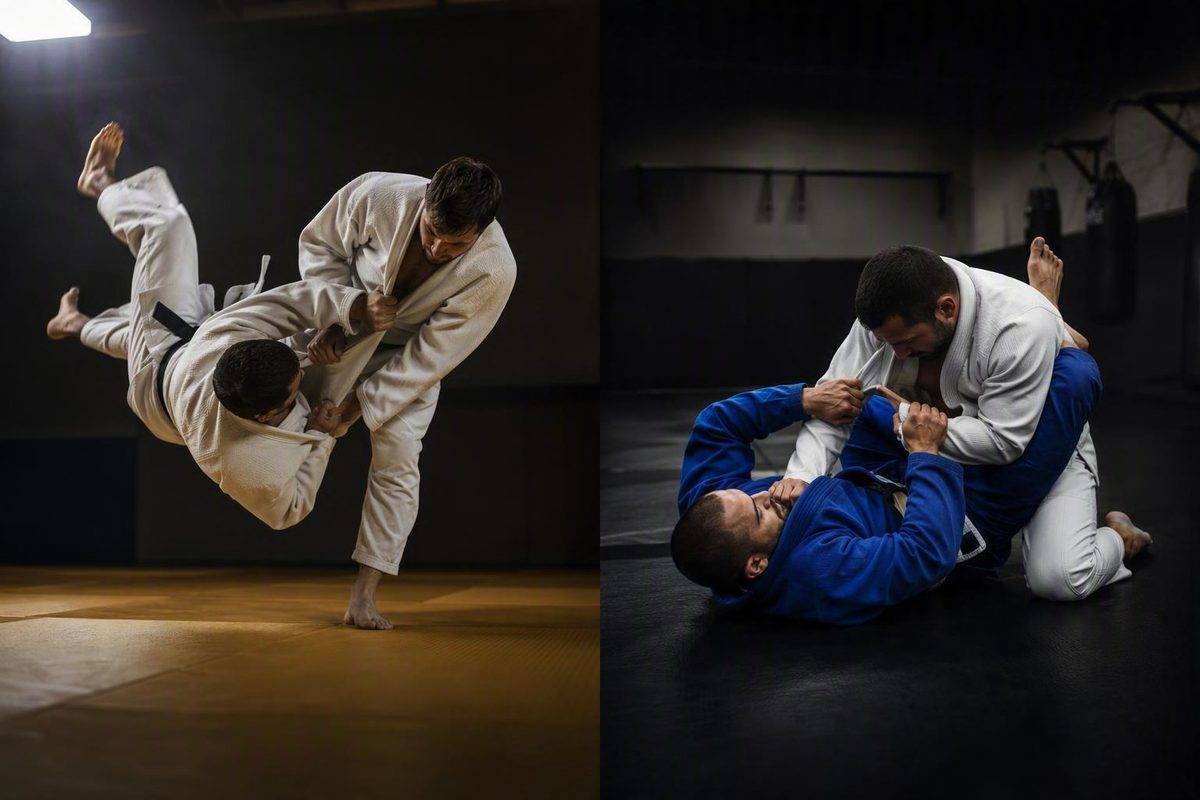
Choose judo if standing throws, takedowns, grip fighting and learning to fall are what make you want to train. Choose Brazilian jiu-jitsu (BJJ) if guard work, escapes, positional control, chokes and joint locks hold your interest. Both arts contain all of those skills; they differ in how much class time each one gets.
That difference in emphasis is real, but for a beginner it matters less than the room. The better practical choice is the local school with attentive coaching, controlled progression, a schedule you can keep, and a curriculum that matches what you want. Take one beginner trial class at each and let the rooms decide.
Pick what drew you to grappling and rate each trial class; the verdict updates beside the controls.
Judo Club or BJJ Academy: Which Room Should You Join?
Judo club scorecard
BJJ academy scorecard
Take both trial classes first
Pick what draws you to grappling and rate each trial class; the verdict updates here. A school you have not visited stays unknown, not zero.
| Judo room | BJJ room | Verdict |
|---|---|---|
| Better run | Worse run | Judo club, whatever your style preference |
| Worse run | Better run | BJJ academy, whatever your style preference |
| Good | Good | Judo if throws excite you; BJJ if groundwork does |
| Poor | Poor | Keep looking |
Rule from the article: a clearly better-run school beats style preference; two good schools go by preference; two poor schools mean keep looking. Ratings are your own trial-class observations, not measured data. In the scorecard, a Poor on any of the first three (safety) factors marks that school poorly run.
Judo Spends Its Time Standing, BJJ Spends It on the Ground
A typical judo club devotes most of its time to posture, movement, gripping, off-balancing, foot sweeps, throws, takedowns and controlled falling. A typical BJJ academy devotes most of its time to surviving, escaping, controlling, advancing position and submitting an opponent on the ground.
| Comparison | Judo | BJJ |
|---|---|---|
| Primary emphasis | Throws, takedowns, grip fighting | Guard, escapes, control, submissions |
| Typical starting phase | Standing | Matches start standing; class rounds may start standing or on the ground |
| Broad win conditions | Decisive throw, pin, or permitted submission | Submission, or points for position |
| Attire and formats | Predominantly gi | Gi and no-gi; points and submission-only formats |
Judo includes pins, chokes, permitted armlocks and live groundwork. BJJ includes throws, takedowns and standing grip exchanges. Their shared techniques are filtered through different competitive and instructional priorities.
Individual curricula vary a lot. One BJJ academy teaches takedowns every week while another spends almost every session on the ground; one judo club gives real time to live groundwork while another drills throws almost exclusively. Practitioner reports describe exactly this spread, so ask about the timetable rather than assuming the style name describes the whole program (Martial Arts Stack Exchange discussion of judo and BJJ overlap).
What a Beginner Class Looks Like in Each Art
A judo class usually starts with standing movement and grip fighting. You work on controlling a sleeve and collar, disrupting posture, creating an angle, and using timing to land a foot sweep, hip throw or another takedown. Practice progresses from cooperative repetitions to moving entries and then resistant stand-up sparring, called randori.
Judo beginners also spend substantial time on ukemi, or breakfalls. Ukemi teaches organized ways to land and prepares you to be thrown. It does not make throws harmless. A well-run club moves from solo falling and controlled partner drills toward resistant throwing rather than dropping a new student into hard stand-up rounds; structured fundamentals and controlled live work are the onboarding principles that matter in any combat sport (MMA Spark’s beginner training guidance).
Judo’s ground phase, newaza, covers pins, turnovers, escapes, chokes and permitted armlocks, but usually with less time for gradual positional development than BJJ allows. A judoka often tries to secure a pin or submission quickly before the exchange is stopped and returned to standing.
A BJJ class is more likely to build its technical block around a position: closed, open or half guard, side control, mount, back control, turtle, or a passing or submission position. You learn sweeps, reversals, guard passes, escapes, transitions, chokes and joint locks. Sparring produces longer ground exchanges in which one person tries to improve position while the other retains guard, escapes, reverses or attacks. Some rounds start standing; others begin from a designated ground position to focus practice or manage a crowded mat.
Judo is predominantly gi-based, and the jacket supports extensive sleeve-and-collar grip fighting. BJJ commonly offers both gi and no-gi classes, though a given timetable may lean heavily toward one.
The overlap has historical roots. Jigoro Kano established the Kodokan in 1882, and BJJ later developed from Kodokan judo transmitted to Brazil. The lineage is often simplified, but it explains why both arts contain throws, pins, chokes and joint locks despite allocating training time differently (Digitsu’s historical and technical overview).
Two myths deserve a direct answer. “Judo has no ground game” is wrong: judo includes pins, turnovers, chokes, armlocks and live groundwork, though its rules and class structure push you to act quickly on the ground. “BJJ has no takedowns” is also wrong: takedowns are part of BJJ and organized matches begin standing, but an individual academy may spend little class time on them. The useful question is not whether an art contains a skill but how often the local program practices it against resistance.
Competition Rules Shape the Grapplers Each Art Produces
In judo, a sufficiently decisive throw ends the contest immediately. A match can also end through a pin or a permitted submission. When groundwork stalls, the referee stands the athletes back up.
In common points-based BJJ formats, a submission ends the match. Otherwise competitors are rewarded for takedowns, sweeps, passing guard and establishing dominant positions. Longer ground exchanges give athletes room to retain guard, escape bad positions, advance in stages, or build toward a submission.
Those incentives produce recognizable habits. Judoka repeatedly practice entering through resistance, disturbing balance, completing a throw and securing top control. BJJ practitioners repeatedly practice layered positional problems: escaping, retaining guard, passing, stabilizing control, submitting. Gi BJJ athletes often borrow heavily from judo gripping and throwing.
BJJ is not one competitive format. It includes gi and no-gi divisions, points-based tournaments, submission-only events, and promotions with their own rules. Judo rules also differ by governing body and competition category. Do not treat a generic points chart, match duration, grip restriction, pin time or submission list as universal; if you intend to compete, read the current rules for the specific event.
Neither Art Wins Self-Defense or MMA Outright
“Which is better for self-defense?” is too broad for a responsible single winner. Self-defense can mean staying upright, managing a standing clinch, surviving an unexpected fall, escaping from underneath someone, controlling one person, creating space to disengage, or recognizing when leaving is possible.
Judo makes a reasonable case in the standing phase, with two caveats: gi grips transfer most directly when the other person is wearing suitable clothing, and a clean mat does not reproduce concrete, stairs or a confined space. BJJ makes a reasonable case once an encounter has reached the ground.
Neither strength settles the question. Prolonged ground engagement outside sport exposes you to hard surfaces, weapons, trampling and additional attackers. Expecting to remain standing in every encounter is equally unrealistic. Practitioner discussions raise these hazards, but their conclusions are opinion and experience, not controlled comparative evidence (Martial Arts Stack Exchange discussion of self-defense claims). Outcomes depend on the people involved, their skill, size, fitness, clothing, terrain, weapons, bystanders and whether there is a safe exit.
If MMA is your destination, judge the school’s actual integration with striking and wrestling rather than the art’s reputation. Either base can work; a room that never puts grappling next to punches will leave the same gap regardless of style.
Injury Evidence Exists for BJJ, Not for the Comparison
Judo and BJJ stress the body differently, but the available evidence does not justify declaring one universally safer.
Judo involves repeated falling, standing grip battles, off-balancing and resistant throwing exchanges. BJJ involves prolonged close-contact groundwork, positional sparring, joint locks, chokes and, depending on the school, takedowns. Coaching, partner behavior, progression, intensity and weekly workload shape the experience more than the style label.
A retrospective cross-sectional survey included 1,140 active BJJ athletes from 62 countries. Two out of three respondents reported at least one injury during the preceding three years that cost them at least two weeks of training. Of the reported injuries, 77.6% occurred during sparring. Knees were the most commonly reported region at 27.1%, shoulders accounted for 14.6%, and submissions, takedowns and guard passes were the leading reported mechanisms (cross-sectional survey of 1,140 BJJ athletes).
Those figures have firm limits. The study relied on self-report and three-year recall, recruited through English-language social media, excluded injuries causing less than two weeks away, and capped respondents at three injuries each. Its denominator was athletes per year rather than training hours, rounds or matches, so it is not an exposure-adjusted injury rate.
A smaller survey of 70 practitioners at one Canadian BJJ club also found injuries commonly reported during regular training rather than only in competition. Its single-club sample, self-reported data and lifetime-style reporting sharply limit how far it generalizes (single-club BJJ injury survey).
Both studies concern BJJ. They cannot say whether judo or BJJ is safer. A real comparison would need compatible injury definitions, comparable populations and exposure measures such as training hours or matches. No such figure appears in the sources for this article.
What you can control is the room. During a trial class, watch whether beginners are paired with composed partners, whether the coach stops uncontrolled exchanges, whether partners release submissions the instant someone taps, whether takedowns are introduced progressively, whether fatigue lowers intensity rather than control, whether anyone can sit out a drill without being mocked, and whether there is enough mat space for the number of people training.
If you have prior knee, shoulder, neck or fall-related concerns, talk to an appropriate clinician and a qualified coach who can watch you move. A general comparison cannot prescribe an art for a medical condition.
Two Trial Classes Settle It
Take one beginner-friendly trial class at each local school, at the time you could attend regularly. Do not compare a quiet judo fundamentals class with an advanced BJJ competition session. Compare the programs genuinely available to you.
| What to assess | BJJ academy | Judo club |
|---|---|---|
| Curriculum | How often do rounds start standing, and do beginners get structured takedown instruction? | How much class time covers pins, escapes, chokes, armlocks and live groundwork? |
| Beginner progression | How are submissions introduced, and how is tapping taught and enforced? | Do beginners learn breakfalls and controlled throwing progressions before full resistance? |
| Available formats | Are gi and no-gi classes offered at times you can attend? | Are technical and live sessions suitable for adult beginners? |
| Live training | Are rounds supervised and matched by experience and size where practical? | Is randori introduced progressively with controlled partners? |
At the BJJ academy, ask how often you will learn takedowns and how often beginner rounds start standing. Ask whether both gi and no-gi are available, how chokes and joint locks are introduced, whether advanced submissions show up in beginner rounds, and how coaches enforce controlled application.
At the judo club, ask how much newaza adult beginners actually train, and whether that means regular pins, escapes, turnovers, chokes, armlocks and live ground rounds rather than occasional demonstrations. Watch how the club teaches falling and how gradually it adds resistance.
Then weigh the factors that matter regardless of style: whether the coach notices unsafe movement and gives usable corrections, whether there is a clear path from drilling to positional work to live sparring, whether partners can train technically without every round becoming a contest, whether there are suitable partners for your size and experience, whether the mats and loaner gear are clean, whether the schedule and commute survive a bad workday, whether the full cost including uniform fits your budget, and whether the class made you want to come back.
The decision rule is simple. If one school is substantially better run, choose that school. If both are good, choose judo if throws and standing grip fighting excite you more, and BJJ if prolonged groundwork, escapes, control and submissions do. If neither school manages beginners responsibly, keep looking.
Cross-training is optional and can wait. Judo sharpens a BJJ practitioner’s standing entries and gi grips; BJJ gives a judoka longer positional and submission-oriented ground exchanges. Build consistency in one good room first, then add the complementary art if schedule, budget and recovery allow.
For a recreational athlete with a day job, a well-run class you can attend consistently beats an idealized program you rarely reach. Choose the room whose coaching, progression, schedule and curriculum make you want to keep training.