
Throws or Groundwork? How to Choose Your First Grappling Art
Judo emphasizes standing grips, breakfalls and takedowns; BJJ goes deeper into guard, escapes, positional control and submissions.
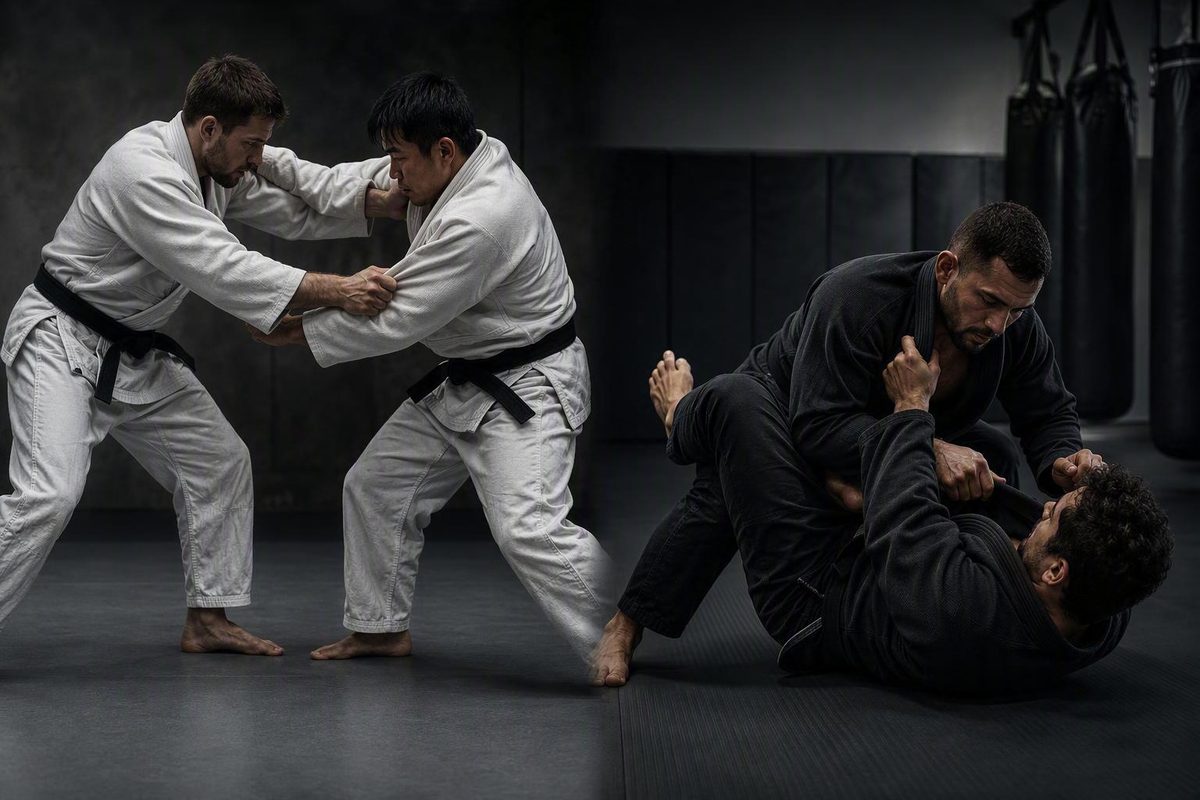
Choose judo if standing grip fighting, breakfalls, takedowns, and throws excite you most. Choose Brazilian Jiu-Jitsu (BJJ) if you would rather spend more time learning guard, escapes, positional control, and submissions.
Neither art is universally better. For a recreational beginner training around a day job, the better choice is the one whose classes you enjoy, whose schedule you can maintain, and whose coaches manage beginners responsibly.
The short answer: judo favors throws; BJJ favors prolonged groundwork
In this comparison, “jitsu” means Brazilian Jiu-Jitsu. Traditional Japanese jujutsu is a broader category that varies substantially among schools, so it should not be treated as interchangeable with BJJ.
The main difference is emphasis, not exclusivity. Judo usually begins from standing and invests heavily in gripping, footwork, balance breaking, safe falling, and throwing. BJJ generally devotes more class time to extended ground exchanges: playing and passing guard, escaping bad positions, controlling dominant positions, and finding submissions.
Judo still includes pins and permitted submissions on the ground. BJJ still includes clinching and takedowns.
| Comparison | Judo | Brazilian Jiu-Jitsu |
|---|---|---|
| Primary emphasis | Throws and standing control | Ground position and submissions |
| Typical starting phase | Standing | Standing or a defined ground position |
| Standing skills | Grips, footwork, off-balancing, entries, trips, and throws | Clinches and takedowns, usually with less class time devoted to them |
| Ground skills | Fast transitions, pins, turnovers, chokes, and permitted joint locks | Guard, passing, sweeps, escapes, mount, back control, and submissions |
| Live practice | Randori | Positional sparring and rolling |
| Clothing | Predominantly gi | Gi and no-gi are both common |
| Common competition objective | Decisive throw, hold-down, or permitted submission | Submission or victory through ruleset-specific positional scoring |
| Best fit | You want to become comfortable falling and attacking from standing | You want longer, layered ground exchanges |
These broad differences are reflected in NAGA’s comparison of judo and Brazilian Jiu-Jitsu, although exact curricula and competition rules vary.
Ask which experience you want to repeat every week. If learning to unbalance and throw a resisting partner grabs you, start with judo. If solving position-by-position problems on the mat sounds more appealing, start with BJJ. If both appeal, let the quality and practicality of the local programs decide.
What you actually learn: a phase-by-phase comparison
The simplest way to understand jitsu vs judo is to follow an exchange from its opening grip to its finish.
Standing engagement: Judo spends substantial time on posture, movement, grip fighting, off-balancing, foot sweeps, turn-in attacks, and throw combinations. You learn not only how to execute a throw but how to create the reaction that makes it possible.
BJJ students may also start rounds standing and learn wrestling shots, body locks, trips, throws, or guard pulls. The difference is usually the depth and time devoted to this phase, not whether stand-up grappling exists at all.
Takedown and transition: A judoka trains to pursue a decisive throw and capitalize immediately if the exchange continues on the mat. That may mean securing a hold-down, turning an opponent, or attacking an available submission. The transition matters because the opponent may rotate, land partially, or begin escaping as soon as contact with the mat occurs.
In BJJ, the takedown usually opens a longer positional problem. Landing on top does not settle the exchange if the other person establishes guard. The top player may need to control distance, clear the legs, pass, stabilize side control, and advance. The bottom player may frame, recover guard, sweep, wrestle up, or attack a submission.
Ground positions: BJJ develops a more extensive vocabulary around sustained ground fighting. Beginners commonly encounter closed and open guard, half guard, side control, mount, back control, turtle, sweeps, guard passes, escapes, and positional transitions. Each position has its own goals, threats, and chains of response.
Judo groundwork is neither empty nor purely defensive. It includes pins, turnovers, chokes or strangles, and permitted joint locks. Its competitive structure generally favors immediate, productive attacks rather than long sequences of incremental guard work.
Finishes: Both arts use chokes or strangles and joint locks within the rules applicable to the class or competition. Judo also treats hold-downs as important match-ending tools. In BJJ, dominant positions commonly create a route to submission or contribute to a scoring lead in points-based formats.
Neither system is “strength versus technique.” Both depend on leverage, timing, posture, positioning, control, and the ability to apply technique against resistance. Athleticism helps in both, but it does not replace technical skill.
How competition rules shape the skills you develop
Rules do more than decide winners. They affect what competitors practice, which openings they pursue, and how urgently they move through each phase.
Judo competition strongly rewards a decisive throw. The broad competition frameworks described in comparative sources also allow victory through a hold-down or a permitted submission, encouraging competitors to connect standing attacks with immediate ground control. Unproductive groundwork may lead to a return to standing, which gives athletes an incentive to act quickly rather than settle into an open-ended ground exchange.
Many BJJ points formats reward actions such as takedowns, sweeps, guard passing, mount, and back control, while a successful submission ends the match immediately. Submission-only formats may omit positional scoring and make the finish the central result. These are general patterns rather than a universal scoring chart.
Rules governing points, grips, submissions, match length, uniforms, guard pulling, penalties, and resets vary by organization, event, age, rank, and gi or no-gi division. A third-party overview of common judo and BJJ competition formats can provide orientation, but competitors should use the current rules published for their specific event.
This rule-to-skill relationship helps explain why related grappling arts can look so different. Judoka are repeatedly rewarded for creating and exploiting short standing opportunities. BJJ practitioners are often rewarded for solving prolonged positional exchanges. Neither competition format represents everything its art can contain; it shows what that particular ruleset rewards most consistently.
What a beginner class feels like
A beginner judo class may include a warm-up, breakfall practice, movement or grip drills, and a throw taught in stages. You might rehearse the footwork first, then add off-balancing and an entry before completing the throw with a cooperative partner. Depending on the instructor and your readiness, class may finish with restricted or open randori.
A beginner BJJ class may start with movement drills or a short warm-up, followed by instruction from a defined position. The coach might teach an escape from mount, a guard pass, or a submission and its setup. Partners drill the sequence before moving into positional sparring or rolling when appropriate. One gym’s description of typical judo and BJJ classes reflects these broad patterns, but individual programs differ.
The physical experience is also different. Judo involves repeated standing entries, rapid balance changes, gripping, and falls. BJJ generally involves more sustained floor movement, close body contact, kneeling or seated positions, gripping, and pressure. Your movement background, pace, partner, and instructor will determine which feels harder.
Judo is predominantly practiced in a gi because the jacket and trousers provide central gripping surfaces. BJJ commonly offers both gi and no-gi classes.
For beginners, MMA Spark’s editorial position is straightforward: prefer structured instruction and controlled live work over a sink-or-swim introduction. A sound beginner policy should treat tapping as a normal way to end an exchange, teach falling progressively before increasing throwing force, and allow new students to regulate intensity.
For your first class, check:
- Does the instructor know who is new and watch beginner pairs?
- Are partners matched sensibly by experience, size, and temperament?
- Do partners stop immediately when someone taps?
- Can students ask to reduce the intensity or decline a round?
- Are the mats, changing areas, and shared equipment clean?
- Is there a clear way for beginners to participate?
- Can you realistically attend this schedule after a normal workday?
A technically impressive gym is still a poor fit if the commute prevents consistent attendance or every session leaves you unable to recover for work.
Decision matrix: choose by the training you want to repeat every week
Choose according to the work you want to practice, not an abstract claim that one style wins every comparison.
| Your preference | Try first | Why |
|---|---|---|
| Throws and standing grip fighting | Judo | More training time centers on creating and finishing standing attacks |
| Guard, escapes, and extended submission exchanges | BJJ | Ground positions and transitions receive greater depth |
| No-gi training | BJJ | No-gi is a common BJJ format |
| Repeated breakfall practice | Judo | Falling skills are foundational to regular throwing practice |
| You dislike repeated falling | BJJ | A controlled BJJ trial may suit you better, although takedowns can still be included |
| You dislike prolonged close contact on the floor | Judo | More training remains standing, although judo still includes groundwork |
For recreational training, enjoyment and logistics usually matter more than theoretical superiority. Compare the commute, timetable, beginner curriculum, coaching attention, partner matching, cleanliness, and room culture.
For competition, investigate the opportunities available locally. Read the current rules for the exact event instead of assuming that every BJJ tournament uses the same scoring system or every judo division permits the same techniques.
For MMA, the arts offer different parts of a larger game. Judo can contribute standing grips, off-balancing, throws, and rapid takedown-to-ground transitions. BJJ can contribute guard work, escapes, positional control, and submissions. Neither art alone covers that full problem.
For self-defense, there is no responsible universal winner.
If practical, take one beginner class in each. Judge the actual instruction and training environment rather than choosing solely by the style name.
Can you train judo and BJJ together?
Yes. Their overlap makes them complementary rather than redundant.
Judo can deepen your standing grip work, footwork, off-balancing, throwing combinations, breakfalls, and transitions from takedowns into control. BJJ can deepen your guard, escapes, passing, positional chains, back control, and ability to continue when the first ground attack fails.
For a hobbyist with a day job, however, “do both” is not automatically the best starting answer. Establish a consistent routine in one art first. Once its vocabulary, recovery demands, and weekly rhythm feel manageable, add occasional training in the other if your schedule allows.
Every additional session still adds workload.
Tell both coaches that you cross-train. Local curricula and competition rules may differ on grips, posture, submissions, guard pulling, and tactically appropriate reactions. A habit rewarded in one room may expose you in the other. Effective cross-training means understanding where each habit applies, not simply collecting more techniques.
Safety: what the evidence can and cannot tell you
The BJJ studies discussed below do not provide a direct judo-versus-BJJ injury comparison. They therefore cannot establish that either art is safer for a beginner.
One study surveyed 70 practitioners at a single Canadian BJJ club. Participants self-reported more injuries in training than in competition, with sprains and strains among the injury types and the fingers, upper extremities, and neck among affected areas. The small, single-club sample and questionnaire design limit how broadly those findings can be applied, as the authors’ peer-reviewed BJJ injury study makes clear.
A separate questionnaire study included 108 adult BJJ competitors from two Brazilian tournaments. Shoulders and knees were commonly reported injury sites among novice and advanced groups. The sample was self-selected, the findings were self-reported, and the groups differed in experience, so the results identify areas to watch rather than a universal injury rate. Those limitations are detailed in the competitor injury-prevalence study.
When choosing a gym, ask:
- How are beginners matched for drilling and live rounds?
- Are students expected to release immediately when a partner taps?
- How does judo instruction introduce breakfalls and throwing force?
- Can beginners decline a round or request lower intensity?
- Does the coach intervene when size, experience, or aggression is mismatched?
- How is live resistance introduced?
- Can students increase training volume gradually?
Combat sports carry real injury risk. MMA Spark’s guidance cannot replace a qualified coach who can observe how you move, match you appropriately, and adjust the training in real time.
Bottom line: Choose judo for a deeper focus on standing grips, breakfalls, takedowns, and throws. Choose BJJ for a deeper focus on guard, escapes, positional control, and submissions. If both interest you, begin with the local program you can attend consistently and consider cross-training later if your schedule and recovery support it.
Frequently asked questions
Is judo better than BJJ for takedowns?
Usually, judo is the better first choice if takedowns—especially gi-based throws, trips, and foot sweeps—are your main priority. It generally dedicates more training time to standing grips, balance breaking, entries, combinations, and safe falling.
BJJ also teaches takedowns, but the amount and quality of stand-up instruction vary considerably among gyms. An academy with dedicated wrestling or judo sessions may offer more takedown practice than the average style comparison suggests, so inspect the local timetable.
Does judo include ground fighting and submissions?
Yes. Judo groundwork includes pins, turnovers, chokes or strangles, and permitted joint locks. Competition incentives generally make these exchanges faster and more direct than the prolonged guard-and-passing sequences common in BJJ, but judo is not a standing-only art. Exact permitted techniques depend on the applicable rules.
Does BJJ teach takedowns?
Yes. BJJ can include wrestling shots, body locks, trips, throws, and other ways of bringing an opponent to the mat. Some competition formats also permit guard pulling. How much standing practice you receive depends heavily on the academy, instructor, and whether the class is gi, no-gi, competition-focused, or recreational.
Do both judo and BJJ use a gi?
Yes. Judo is predominantly gi-based, and the uniform is central to its gripping system. BJJ also has a major gi tradition, but no-gi BJJ is widely practiced as a separate format. If you specifically want to train without a jacket, BJJ is normally the clearer option.