
Peekaboo Boxing: Learn the System, Not Just Tyson’s Guard
Understand peekaboo boxing’s guard, head movement and entries, with a controlled beginner drill and practical adjustments for MMA training.
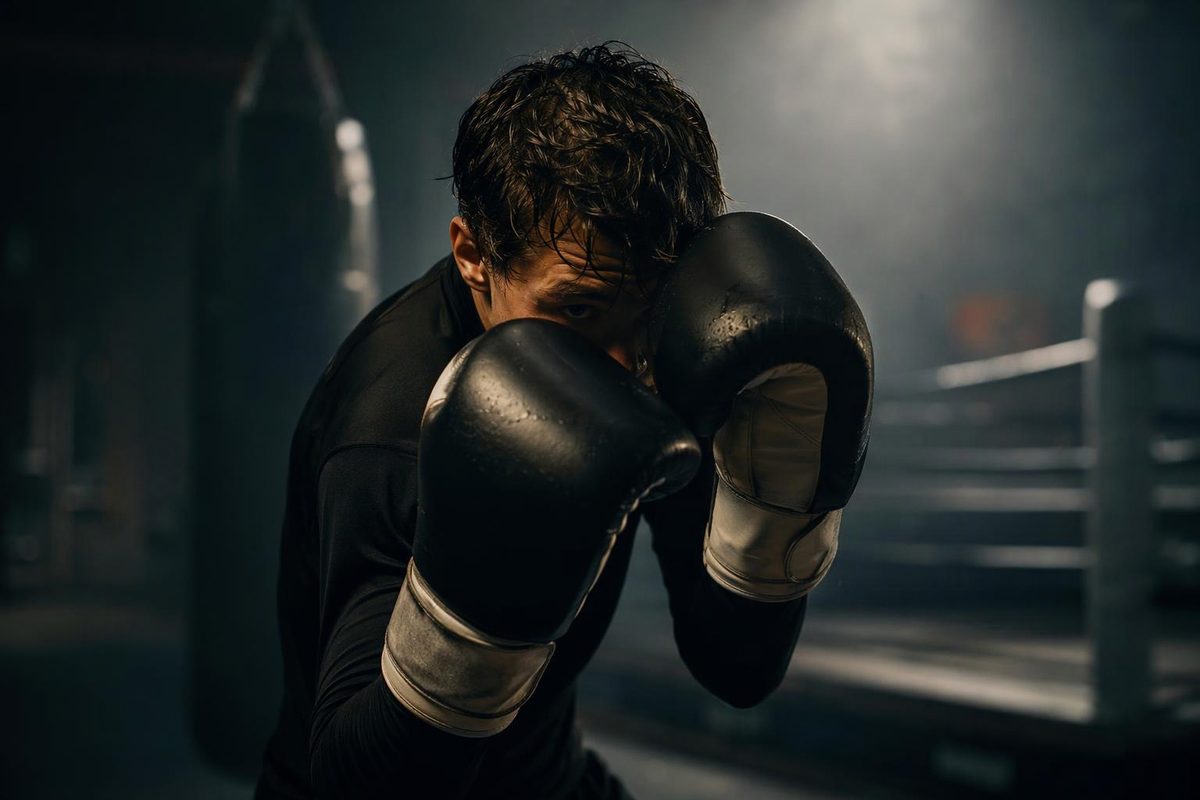
Peekaboo boxing combines a tight high guard, active head movement and footwork that brings a fighter into punching range. It is associated with trainer Cus D’Amato and, most famously, Mike Tyson. The point is not simply to cover your face: it is to connect defense, entry, counterpunching and repositioning. Evolve MMA’s beginner guide describes that proactive approach—creating exchanges rather than waiting outside for a counter.
For a recreational MMA beginner, treat peekaboo as something to explore with your coach, not a replacement for your gym’s basic stance. Start with its compact guard and balanced movement rather than copying Tyson’s speed, deep dips or explosive stance switches.
How the parts work together
1. Guard and base
The recognizable guard places both hands close to the cheeks and chin, with the elbows near the body. Keep your chin down enough to protect it without losing sight of the person in front of you.
Peekaboo often uses a more squared torso than a conventional, side-on boxing stance. That does not mean abandoning balance or putting your feet together. Start from the balanced boxing stance your coach has taught you, then let them adjust it for the style and training rules.
Checkpoint: Can you see forward, take a short step in any direction and return a punch to guard without first rebuilding your stance?
Boxing coach Jason Van Veldhuysen emphasizes maintaining the protective hand-and-forearm position and adapting the style to the individual, rather than imitating Tyson’s particular version. His explanation of peekaboo fundamentals is useful here. Treat the high guard as one defensive tool, not a guarantee that punches cannot get through.
2. Head movement with a purpose
A slip moves your head off the path of a straight punch. A roll, or weave, moves it down and across beneath a hook. For initial practice, keep the movement small, your knees soft and your eyes forward. Avoid folding at the waist or swinging your head as far as possible. These basic mechanics are described in RDX’s head-movement guide.
In peekaboo, head movement connects to your feet and next attack; it is not just repeated bobbing while you stay planted. Have your coach check the movement before adding a partner.
Checkpoint: After the slip, can you punch or step immediately without stumbling or needing to stand back up?
3. Entry, punches and an exit
Moving your head does not close distance by itself. Peekaboo uses footwork alongside defensive movement to reach a position for punches, including compact hooks and uppercuts. Its more advanced patterns include shifts that change stance or create a side angle. Evolve’s guide explains these patterns, but they are not the place to start independently.
For a beginner, learn one short entry, a one- or two-punch response and a balanced exit. Think move into position, punch, reposition—not duck repeatedly and charge forward. Van Veldhuysen likewise stresses head movement before and after punching, balanced pressure and angles.
What changes in MMA?
MMA combines striking and grappling, standing and on the ground; a boxing exchange is only part of the problem. The UFC’s introduction to MMA outlines that broader scope.
Ask your coach to check three things before transferring peekaboo habits into MMA rounds:
- Head position: Does a dip intended to avoid a punch put your head into a possible kick or knee path? Do not rehearse deep, repetitive ducks as an automatic response.
- Guard coverage: MMA gloves have a different, less padded design than boxing gloves. Do not assume a shell that works with large boxing gloves provides the same coverage with smaller gloves. Engage’s glove comparison explains the design differences.
- Close-range decisions: Once you enter, you may need clinch control or takedown defense rather than another punching combination. Practice that transition separately through coach-led MMA infighting work.
These are reasons to adapt the style, not to discard head movement or high guards.
A controlled starting drill
Use this as a short, non-contact introduction—not a complete peekaboo curriculum. Have your coach choose the slip direction and counter first. Try three one-minute rounds, resting a minute between them. Stay slow enough to check your position.
- Guard and movement: Hold your guard and take short forward, backward and lateral steps. Stop occasionally to check your balance and sightline.
- Slip and entry: Imagine a straight punch. Make the small slip and short forward step your coach demonstrated, then reset. Do not add stance switches yet.
- Connect the sequence: Repeat the entry, throw one or two relaxed shadow punches, return your hands and step away at an angle.
When your coach approves the movement, practice under their supervision against a predictable partner jab that stops short of your face. Then add the selected counter on pads and an exit. Save unpredictable exchanges for supervised technical rounds with explicit contact limits.
The useful test is whether you can keep seeing, stay balanced and leave the exchange—not whether the movement looks like a Tyson highlight.